- Written by: Hummaid Naseer
- November 17, 2025
- Categories: Services & Products
In the startup world, the biggest risk isn’t building your product wrong. It’s building the wrong product altogether. Many founders pour months (or years) into perfecting features, refining design, and chasing polish before ever confirming whether anyone truly wants what they’re creating. The result? A beautifully executed solution to a problem that doesn’t exist.
Idea validation flips that script. It’s about proving demand before investing heavily in development. Instead of guessing what users need, you test, learn, and adapt fast. By validating your business idea early, you reduce risk, attract investor confidence, and lay the groundwork for building something people genuinely care about.
What Is an MVP (Minimum Viable Product)?
A Minimum Viable Product (MVP) is one of the most misunderstood concepts in entrepreneurship. Many people assume it’s a “lite” version of the final product, something rushed, basic, or cheaply made. In reality, an MVP is a strategic learning tool designed to validate whether your business idea truly meets a market need before you invest significant time and money into full-scale development.
At its core, an MVP is the simplest form of your product that allows you to test your key assumptions with real users. It includes only the essential features necessary to solve a specific problem for a particular audience, nothing more. By launching this focused version, you can observe how people actually use the product, what they value, and what they ignore or struggle with. This feedback becomes your compass for what to build next.
The purpose of an MVP isn’t to look perfect or to be packed with features. It’s to learn fast, fail cheap, and iterate intelligently. It allows founders to answer critical questions early, such as:
Do people truly have the problem I’m trying to solve?
Will they use my product as intended?
Are they willing to pay for this solution?
What features matter most to them?
For example, Dropbox began with a simple explainer video to test if people were interested in seamless file syncing, long before building the actual technology. Airbnb started with a single apartment to see if strangers would pay to stay in someone’s home. Both companies used MVPs not to make money right away, but to confirm their ideas had real demand.
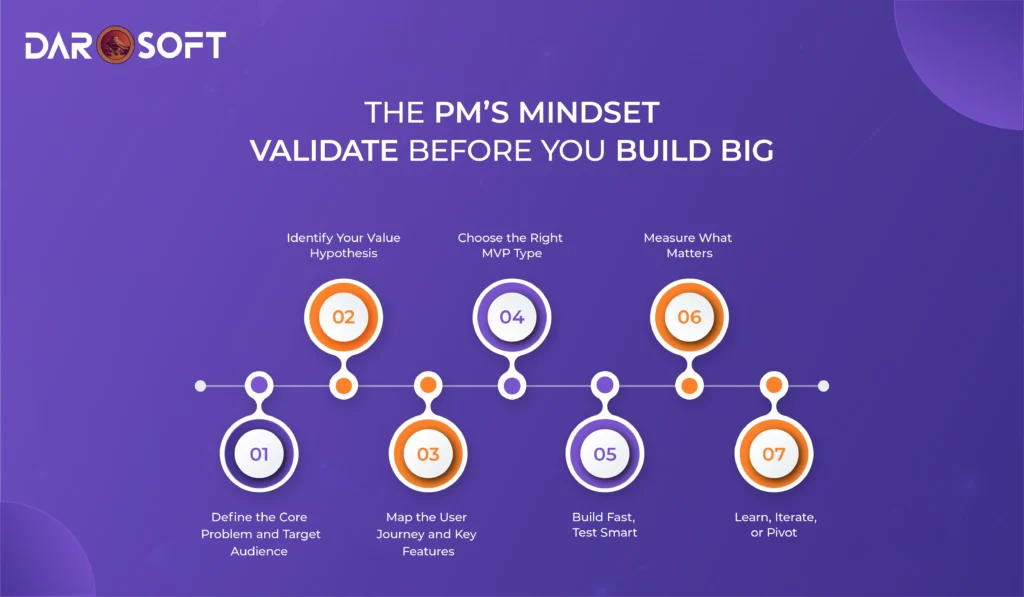
The PM’s Mindset: Validate Before You Build Big
A successful MVP isn’t just about building fast. It’s about building smart. That’s where a project manager’s mindset becomes essential. Great PMs don’t rush to launch a full-featured product; they focus on minimizing risk, maximizing learning, and managing scope with precision.
From a project management perspective, an MVP isn’t a smaller project. It’s a more strategic one. The goal is to validate assumptions early, before major resources are spent. PMs act as reality-checkers, ensuring the team focuses on testing the most critical hypotheses rather than getting lost in unnecessary features or aesthetics.
Here’s how experienced PMs approach MVPs strategically:
1. Start with the core problem, not the product.
Instead of defining what to build, they clarify why it’s being built. They identify the user pain point, map the assumptions behind it, and set measurable learning goals for validation.2. Manage scope ruthlessly.
Every feature competes for attention and resources. PMs cut through the noise to prioritize what’s truly essential for learning. Anything that doesn’t contribute to validation gets deferred, no matter how “cool” it sounds.3. Define success through data, not opinions.
A good MVP has clear metrics: signups, engagement, conversion, retention, or even qualitative feedback. PMs design experiments that provide concrete insights instead of relying on gut feeling or team bias.4. Embrace iterative learning cycles.
The MVP process isn’t linear. PMs expect to pivot, adjust, and refine based on what real users say and do. They create short, focused feedback loops that help the team learn quickly and adapt continuously.5. Balance speed with stability.
While the goal is to move fast, PMs ensure quality doesn’t collapse under pressure. They keep technical debt, documentation, and user experience manageable so future iterations aren’t hindered.
Ultimately, a project manager’s role in MVP development is to protect the vision by controlling the chaos, ensuring every sprint, feature, and test serves the larger purpose of validation. Before scaling, they make sure the foundation is proven. Because in modern product management, success isn’t measured by how much you build. It’s measured by how much you learn before you build big.
Step 1: Define the Core Problem and Target Audience
Before you start building, take a step back and ask yourself one simple question: “Who am I really helping, and why would they care?”
That question might sound obvious, but it’s where most startups stumble. Too often, teams rush to build features, design logos, and buy domains before truly understanding the problem they’re solving. The result? A polished product that nobody actually needs.
Here’s the truth: every great MVP starts with empathy, not code. You need to know your audience like you know your best friend, their frustrations, habits, and what keeps them up at night.
Try this quick exercise:
Picture your ideal user. Give them a name, a job, a routine.
What’s a moment in their day when they hit a wall — when they say, “Ugh, there has to be a better way”?
That moment is your entry point.
For example:
“Emma, a freelance designer, spends hours chasing small unpaid invoices each month. She doesn’t need another finance app; she needs a simple way to track and remind clients automatically.”
See how the focus shifts? You’re not building “a tool to automate payments.” You’re solving Emma’s daily headache.
To make this step powerful:
Talk to real people: not just your friends. Listen more than you pitch.
Ask “why?” five times to uncover the root cause of their frustration.
Validate patterns: if you hear the same pain from different voices, you’ve found something real.
Remember: an MVP doesn’t start with “What should we build?” It starts with “Whose problem are we solving, and how big is the pain?”. Once you can answer that confidently, you’re no longer guessing; you’re building with purpose.
Step 2: Identify Your Value Hypothesis
After defining your audience and the problem you’re solving, the next step is to pinpoint the core assumption your MVP will test. This is called the value hypothesis, the single most important idea that, if proven true, validates your product concept.
What Is a Value Hypothesis?
A value hypothesis answers a simple but crucial question:
“If we deliver X to our users, will it create Y outcome?”
It’s not about features or design; it’s about user behavior. You want to know whether your solution actually works in the real world, not whether it looks perfect.
Examples:
Productivity app: “If freelancers get automated reminders for unpaid invoices, they will collect payments faster.”
Meal delivery service: “If busy parents can order healthy meals in under 5 minutes, they will use the service weekly.”
Language learning tool: “If learners practice 10 minutes daily using gamified lessons, their retention rate will increase.”
How to Craft Your Value Hypothesis
Write a clear assumption – One sentence that links your solution to a specific outcome.
Define success metrics – What behaviors or results will prove your idea works? Examples include sign-ups, purchases, engagement, or repeated use.
Focus on the riskiest assumption – Test the part of your idea most likely to fail first. This is where you’ll gain the most insight.
Why It Matters
By defining your value hypothesis, you turn your MVP into a targeted experiment rather than a vague prototype. Every feature you build, every metric you track, and every user interaction should answer this one critical question:
“Does this deliver real value to real users?”
When your value hypothesis is clear, you can move forward with confidence, knowing that your MVP isn’t just a product, it’s a learning machine.
Step 3: Map the User Journey and Key Features
With your value hypothesis in hand, it’s time to translate assumptions into action. This means understanding exactly how users will experience your product and identifying the essential features needed to validate your idea.
Step 3.1: Map the User Journey
Think of the MVP as a story. Your users are the main characters, and your product is the tool that helps them solve their problem. Mapping the journey involves:
Identifying key touchpoints – Where and how will users interact with your product?
Outlining steps to success – What sequence of actions leads users from problem to solution?
Highlighting friction points – Where might users get stuck, confused, or drop off?
Example: For a freelance invoice tracker:
User signs up → Adds client and invoice info → Receives automatic payment reminder → Checks payment status → Gets notified of payment received.
This simple journey captures the core behavior that validates the value hypothesis: users receiving reminders actually pay faster.
Step 3.2: Define Key Features
Once the journey is clear, list only the features that directly support the user’s path and validate your hypothesis. Remember: the MVP is about learning, not impressing.
Questions to guide feature selection:
Does this feature help test the core assumption?
Would removing it prevent the hypothesis from being validated?
Is this feature essential for users to achieve the outcome?
Example for the invoice tracker MVP:
User account creation (essential)
Client and invoice entry (essential)
Automated payment reminders (essential)
Payment tracking dashboard (optional for first test, could come later)
Step 3.3: Keep It Lean
The goal is a laser-focused scope. Every extra feature adds cost, complexity, and noise — and risks clouding the feedback you need. A lean MVP ensures you can learn quickly, iterate fast, and avoid wasting resources.
By mapping the user journey and defining the must-have features, you transform your hypothesis into a tangible, testable product plan. This is where abstract ideas start to take form, ready to be validated in the real world.
Step 4: Choose the Right MVP Type
Not all MVPs are created equal — the type you choose should match your goal, resources, and risk level. The right MVP lets you validate your core assumption quickly, efficiently, and with minimal cost. Here’s a guide to the most common MVP types and when to use them:
Landing Page MVP
What it is: A simple webpage that presents your idea, value proposition, and a call-to-action (like signing up or joining a waitlist).
When to use: To test demand before building any product.
Pros: Fast, low-cost, and gives early insights into interest.
Example: Buffer launched with just a landing page explaining their scheduling tool — interested users clicked “Sign Up,” validating demand before any product existed.
No-Code Prototype
What it is: A clickable app or website built using no-code tools to simulate the product experience.
When to use: To test usability and flow without heavy development.
Pros: Interactive, visually engaging, and can capture qualitative user feedback.
Example: A marketplace MVP built in Webflow or Bubble to show buyers and sellers how transactions would work.
Concierge MVP
What it is: A highly manual version of the product where you provide the service personally behind the scenes.
When to use: To test if users truly value the service and are willing to pay for it.
Pros: Deep user insight, flexible, and allows for iteration before automation.
Example: Airbnb founders personally met guests and handled bookings manually to validate the concept of renting spaces.
Single-Feature MVP
What it is: A stripped-down version of the product with only one core feature that addresses the main problem.
When to use: When the value hypothesis relies on a specific functionality.
Pros: Fast development, clear focus, and easy to measure success.
Example: Dropbox started with a video demonstrating file syncing, focusing on a single promise rather than building the full software.
Choosing the Right Type
Ask yourself:
What’s the riskiest assumption I need to test first?
How quickly can I launch and gather real feedback?
What’s my budget and resource limit?
Do I need qualitative insights, quantitative validation, or both?
The right MVP type aligns with your learning goals. It’s not about building the perfect product; it’s about testing the idea in the smartest, fastest way possible.
Step 5: Build Fast, Test Smart
Now that you’ve defined your problem, value hypothesis, user journey, and MVP type, it’s time to bring your MVP to life, quickly, efficiently, and with purpose. The goal is not perfection; it’s learning as fast as possible while minimizing wasted effort.
Timebox Your Efforts
Set clear deadlines for each stage of development. Timeboxing forces the team to focus on the essentials, prevents feature creep, and ensures you get something testable into users’ hands fast. Even a two-week sprint can produce a valuable MVP if the scope is well-defined.
Adopt Agile Sprints
Break the build into short, iterative cycles. Each sprint should deliver a usable version of the MVP or a specific feature. After each sprint, review what worked, what didn’t, and adjust the plan. This approach keeps development flexible and aligned with real user feedback.
Leverage Low-Code or No-Code Tools
You don’t need a full engineering team to validate an idea. Tools like Bubble, Webflow, Glide, or Zapier let you build interactive MVPs quickly without heavy coding. This accelerates testing and allows you to focus resources on learning, not infrastructure.
Manage Feedback Loops Efficiently
Collect feedback systematically: Use surveys, in-app prompts, analytics, or direct interviews.
Measure the right metrics: Focus on the behaviors that validate your value hypothesis, sign-ups, engagement, conversions, or repeat usage.
Iterate based on insights: Don’t wait until the “perfect” version is ready. Make adjustments, release updates, and continue learning.
Embrace “Good Enough”
Your MVP doesn’t need to be flashy or feature-packed. It needs to be functional enough to test your assumptions with real users. Remember, every extra feature or polished design element slows down learning and increases risk.
Step 6: Measure What Matters
Once your MVP is in users’ hands, the most important step is tracking the right metrics to validate your assumptions. Without clear measurement, you’re guessing — and guessing at this stage can be costly. The key is to focus on metrics that directly test your value hypothesis, not vanity numbers.
Engagement
Engagement shows whether users are interacting with your product in a meaningful way. Are they taking the steps you expected? Metrics to track include:
Feature usage frequency
Time spent on the product
Completion of key actions in the user journey
High engagement indicates that your solution is resonating with users and addressing their problem.
Conversion
Conversion measures whether users are taking the desired action that demonstrates value. Examples include:
Signing up for a service
Making a purchase
Subscribing to a plan or newsletter
Conversion rates directly confirm if users see enough value to commit, and they are often the most telling metric for validating a hypothesis.
Retention
Retention reflects whether your product continues to deliver value over time. Tracking retention shows if users return, stick around, and integrate your product into their routine. Metrics to consider:
Daily, weekly, or monthly active users
Repeat actions or purchases
Churn rate
Good retention indicates that the core problem is being solved sustainably, not just once.
User Feedback Loops
Numbers alone don’t tell the whole story. Combine quantitative metrics with qualitative feedback to understand why users behave the way they do:
Surveys and polls
User interviews
In-app feedback prompts
Observing user behavior during testing
This feedback helps identify friction points, missing features, and potential pivots.
Focus on Hypothesis Validation
Always link metrics back to your value hypothesis. Ask:
“Does this data prove or disprove our core assumption?”
Avoid chasing vanity metrics like total downloads or page views that don’t reflect real value. Measuring what matters ensures that every insight moves you closer to a validated, scalable product.
Step 7: Learn, Iterate, or Pivot
An MVP’s purpose isn’t just to be built and launched. It’s to generate insights that drive smarter decisions. Once you’ve measured your core metrics and collected user feedback, it’s time to act. This step separates guesswork from strategy: you either iterate, scale, or pivot based on real evidence.
Learn from Real Data
Every interaction with your MVP provides information. Look at:
Engagement patterns: Are users completing key actions?
Conversion rates: Are people taking the steps that validate your value hypothesis?
Feedback: What are users saying about frustrations, missing features, or unmet needs?
This is the raw intelligence that informs the next move. Treat failures as insights, not setbacks.
Iterate
If your MVP partially validates the hypothesis, you can refine and improve. Iteration might involve:
Adjusting feature functionality based on usage patterns
Tweaking the user interface to reduce friction
Adding small, high-impact features to increase value
Iterating allows you to gradually optimize without over-investing in unproven ideas.
Pivot When Necessary
Sometimes, the data shows your core assumption is wrong. A pivot means changing direction strategically, not giving up. Pivots can take many forms:
Targeting a different user segment
Solving a related problem instead of the original one
Adjusting the delivery method or business model
A well-timed pivot saves resources and positions your product for better market fit.
Scale with Confidence
When metrics confirm your value hypothesis and feedback is positive, you can expand the product with confidence:
Add new features that enhance the core experience
Improve performance, design, and usability
Invest in marketing and growth strategies
Scaling only makes sense after validation — otherwise, you risk building a bigger version of an untested idea.
Common Mistakes in MVP Validation
Building an MVP is as much about avoiding pitfalls as it is about following best practices. Many startups stumble not because their idea is bad, but because they fall into common traps that prevent real learning. Here’s what to watch out for — and how to avoid them.
Overbuilding the MVP
The mistake: Trying to include every feature from day one, turning the MVP into a “mini final product.”
The risk: Slower launch, wasted resources, and delayed feedback.
How to avoid it:
Focus only on the features that test your core value hypothesis.
Ask: “Does this directly help validate the assumption?”
Defer everything else to future iterations.
Ignoring Real User Data
The mistake: Relying on assumptions, personal opinions, or vanity metrics instead of actual usage data.
The risk: You think the MVP is successful, but users aren’t engaging as expected.
How to avoid it:
Track quantitative metrics like engagement, conversion, and retention.
Use analytics tools and structured feedback to measure real behaviors.
Let the data guide your next steps.
Skipping User Feedback
The mistake: Launching an MVP without talking to users or collecting qualitative insights.
The risk: You miss pain points, misunderstand user needs, and build features nobody wants.
How to avoid it:
Conduct interviews, surveys, and usability tests.
Observe how users interact with your product — not just what they say.
Treat feedback as essential, even if it contradicts your assumptions.
Validating the Wrong Hypothesis
The mistake: Testing a feature or metric that doesn’t prove your core value proposition.
The risk: You may get “positive” results that don’t actually confirm demand.
How to avoid it:
Clearly define your value hypothesis before building.
Align every experiment and metric with that central assumption.
Moving Too Fast Without Iteration
The mistake: Launching and then immediately scaling without refining based on insights.
The risk: Investing heavily in a product that may not meet real needs.
How to avoid it:
Treat the MVP as the start of a learning cycle.
Iterate quickly based on feedback, pivot if necessary, then scale responsibly.
Build Less, Learn More
MVPs are investments in knowledge, not finished products. Every feature, interaction, and user test is a data point that guides your next decision. By focusing on learning first, you reduce risk, avoid wasted resources, and ensure that when you scale, you’re building something people truly want.
The mindset shift is simple but powerful: less code, less fluff, less guesswork, more learning, more validation, more confidence. Build less, learn more, and let your product evolve from evidence, not assumptions.