- Written by: Hummaid Naseer
- January 20, 2026
- Categories: Case Study, Services & Products
Enterprise Resource Planning (ERP) systems promise operational efficiency, centralized data, and long-term scalability. Yet for many businesses, ERP implementation turns into a financial headache. One of the most common and damaging problems organizations face is high costs and budget overruns.
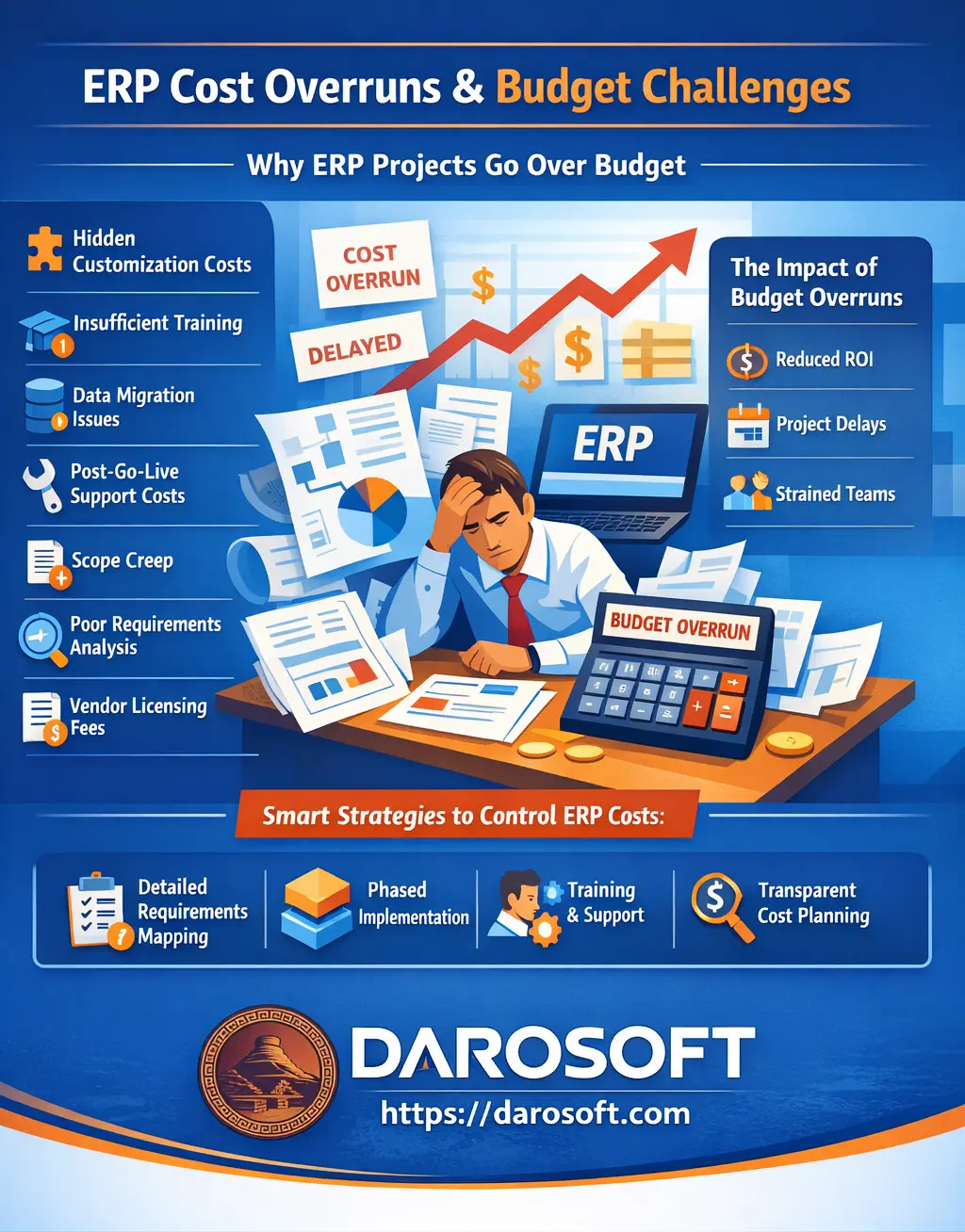
ERP projects often exceed their original budgets due to hidden expenses such as customizations, extended training, data migration challenges, and post-implementation support. In some cases, companies end up spending 40–70% more than initially planned.
This blog explores why ERP costs spiral out of control, the real reasons behind budget overruns, and practical strategies to prevent them.
Why ERP Budget Overruns Are So Common
ERP systems are complex by nature. They touch nearly every department, finance, inventory, HR, procurement, sales, and reporting. When planning is shallow or expectations are unrealistic, costs escalate quickly.
Let’s break down the most common causes.
1. Hidden Customization Costs
Most ERP vendors promote their solutions as “ready to use” or “out-of-the-box.” In reality, every business has unique workflows.
Common customization areas include:
Industry-specific processes
Approval workflows
Tax rules and compliance
Custom reports and dashboards
Integration logic with third-party tools
Each customization requires:
Additional development hours
Testing and rework
Ongoing maintenance
Over time, these “small changes” accumulate into a major budget increase.
Reality: Customization is rarely a one-time cost. It continues throughout the ERP lifecycle.
2. Underestimated Training & Change Management
ERP success depends heavily on user adoption. Many projects allocate minimal budgets for training, assuming users will “figure it out.”
What actually happens:
Employees struggle to use the system
Productivity drops after go-live
Teams revert to spreadsheets and manual workarounds
Extra training sessions become necessary
Hidden costs include:
Repeated training fees
Lost employee productivity
Internal resistance and morale impact
ERP without proper training costs more in the long run than training done right from day one.
3. Data Migration Is More Expensive Than Expected
Data migration is often treated as a technical task, but it’s actually a business-critical process.
Common data issues:
Duplicate records
Incomplete historical data
Inconsistent formats
Incorrect inventory or financial records
Fixing these problems requires:
Data cleanup
Validation cycles
Multiple migration attempts
Each re-run increases consulting fees and delays go-live, both of which inflate costs.
4. Post-Implementation Support & Stabilization Costs
Many ERP budgets focus heavily on “go-live” and ignore what comes after.
After deployment, companies often face:
Performance bottlenecks
Report mismatches
Access and permission issues
Broken workflows under real usage
This leads to:
Emergency support requests
Extended vendor contracts
Additional optimization costs
Post-implementation support is not optional. It’s inevitable.
5. Scope Creep and Feature Expansion
Once teams start using ERP, new requirements emerge:
Advanced analytics
Mobile access
AI or automation features
CRM, logistics, or payroll integrations
If scope is not tightly controlled:
Costs rise
Timelines slip
ROI becomes unclear
What began as “nice-to-have” quickly becomes “business-critical.”
6. Poor Requirement Discovery at the Start
Many ERP projects fail at the planning stage.
Typical mistakes include:
Incomplete process mapping
Lack of department involvement
Over-reliance on vendor demos
No clear success metrics
Without detailed requirements:
Incorrect modules are selected
Customization increases
Rework becomes expensive
7. Vendor Lock-In and Licensing Surprises
ERP pricing models can be complex:
Per-user licensing
Module-based pricing
Charges for integrations, reports, or APIs
Extra fees for upgrades and support
Businesses often discover these costs after implementation has started.
The True Impact of ERP Budget Overruns
ERP cost overruns don’t just affect finances, they affect the entire organization.
Business Impact
Reduced ROI
Delayed digital transformation
Loss of stakeholder confidence
Strained IT and operations teams
In extreme cases, projects are paused or abandoned entirely.
How to Control ERP Costs and Prevent Budget Overruns
1. Start With Detailed Requirement Mapping
Document real workflows before selecting or customizing ERP.
2. Choose Modular & Scalable ERP Systems
Avoid paying for features you don’t need today.
3. Use a Phased Implementation Approach
Roll out core modules first, advanced features later.
4. Budget for Training & Change Management
User adoption is as important as technical success.
5. Plan Data Migration Early
Clean data before migration—not during implementation.
6. Demand Transparent Cost Breakdowns
Every customization, integration, and license should have a clear cost.
7. Include Post-Go-Live Support in the Budget
Stabilization is part of implementation, not an afterthought.
Final Thoughts
ERP systems are powerful, but they are not “plug-and-play.” High costs and budget overruns usually stem from poor planning, hidden assumptions, and underestimated complexity, not from ERP itself.
With the right strategy, transparent costing, and phased execution, ERP can deliver strong ROI without financial surprises.
How Darosoft Helps Businesses Avoid ERP Cost Overruns
At Darosoft, ERP projects are designed with:
Clear scope definition
Modular, phase-based rollouts
Cost-controlled customization
Built-in training and support
Long-term scalability
Result: Predictable budgets, faster adoption, and sustainable growth.