
- Written by: Hummaid Naseer
- July 31, 2025
- Categories: business strategy
Writing tests often comes after the code is finished, almost like an afterthought. However, Test-Driven Development (TDD) completely flips that script. Instead of “write code, then test it,” TDD starts with writing the test first, before a single line of implementation is written.
At first, it might seem counter-intuitive. How can you test something that doesn’t even exist yet? But that’s exactly the point: TDD forces you to think clearly about what your code should do before you start building it. It encourages intentional design, better structure, and early identification of edge cases.
Used well, TDD improves:
- Code quality: You only write what’s necessary to make the test pass.
- Maintainability: Smaller, testable units lead to cleaner architecture.
- Developer confidence: When every change passes a full test suite, you ship with peace of mind.
TDD isn’t just about testing; it’s about writing better, more thoughtful code from the start.
What Is Test-Driven Development (TDD)?
Test-Driven Development (TDD) is a software development approach where you write tests before writing the code that fulfills them. The process follows a simple but powerful cycle:
Red: Write a failing test
Start by writing a test that describes the desired functionality. Since the feature doesn’t exist yet, the test should fail. This failure validates that the test is working and sets a clear target.
Green: Write the minimum code to pass the test
Now write just enough code to make the test pass, extra features or optimisations. The goal is correctness, not perfection.
Refactor: Improve the code with tests still passing
Once the test is green, clean up the implementation. Refactor for readability, performance, or maintainability while ensuring the tests still pass.
TDD in Agile & CI/CD Workflows
TDD fits perfectly into Agile and CI/CD environments:
- In Agile, where features evolve quickly, TDD provides guardrails that let teams move fast without breaking things.
- In CI/CD pipelines, TDD ensures every build is backed by a suite of reliable tests, making automatic deployments safer and more predictable.
TDD helps development stay iterative, incremental, and testable: core values of Agile and DevOps cultures.
TDD vs. Traditional Unit Testing
| Aspect | TDD | Traditional Unit Testing |
| Test timing | Written before the code | Written after implementation |
| Design influence | Drives code structure | Test what’s already built |
| Code coverage | Tends to be higher | Varies, often inconsistent |
| Refactoring safety | High tests guide changes | Lower – may miss edge cases |
| Mindset | Specification-first mindset | Verification mindset |
The TDD Cycle: Red, Green, Refactor
At the heart of Test-Driven Development lies a disciplined loop that keeps your code focused, testable, and clean. The cycle is simple, but transformative:
Red: Write a Failing Test
Start by writing a test that defines what the code should do.
It could be for a function, component, or API behaviour. The test should fail because the functionality doesn’t exist yet.
Why it matters:
- Forces you to think about requirements first
- Helps define clear, testable behaviour
- Confirms your test is valid (a failing test means it’s working)
python
def test_adds_two_numbers():
assert add(2, 3) == 5 # ‘add’ function doesn’t exist yet → test fails
Green: Make the Test Pass (No More, No Less)
Now, write the minimal amount of code needed to make the test pass.
Don’t worry about elegance or optimisation, make it work.
Why it matters:
- Keeps development goal-driven
- Prevents over-engineering
- Builds confidence through small wins
python
def add(a, b):
return a + b # Test now passes
Refactor: Clean the Code While Tests Stay Green
With the test passing, now refactor your code for readability, performance, or structure, without changing what it does.
Why it matters:
- Keeps your code-base clean, DRY, and maintainable
- Your tests act as a safety net. If refactoring breaks something, you’ll know immediately
python
# Refactor might mean renaming, simplifying logic, or extracting methods
# as long as the test still passes.
Why It Works
The Red–Green–Refactor cycle encourages small, safe, continuous improvements.
It turns testing from a safety net into a guiding force for writing better code.
It’s not just a process: it’s a mindset: write only what you need, verify constantly, and clean as you go.
Why TDD Matters
Test-Driven Development isn’t just a developer preference’s a proven approach that delivers real, tangible value across the software life-cycle. Here’s what we consistently gain when TDD is part of the process:
Fewer Bugs and Regressions
By writing tests before code, edge cases are caught early and behaviour is clearly defined. This dramatically reduces last-minute bugs and prevents regressions during future changes.
Improved Design and Architecture
TDD encourages modular, loosely coupled code. You naturally write smaller, more focused functions that are easier to test and easier to reason about. This leads to better separation of concerns and cleaner architecture over time.
Built-in Documentation
Your tests describe what the code is supposed to do clearly, consistently, and automatically. New developers don’t have to guess how a function behaves; the tests explain it.
Easier Refactoring and Onboarding
With a strong test suite, you can refactor with confidence. If something breaks, the tests will catch it. For new team members, well-written tests act as onboarding guides, showing how the system works through real examples.
Higher Developer Confidence and Collaboration
TDD helps developers move faster without fear. When the whole team trusts the tests, collaboration improves. Reviews become more focused, bugs become rarer, and everyone has a shared understanding of what “done” means.
When TDD Works Best (and When It Doesn’t)
Test-Driven Development (TDD) is a powerful tool, but like any tool, it shines in the right context and can become a bottleneck in others. Here’s how to know when to lean into it and when to go lighter.
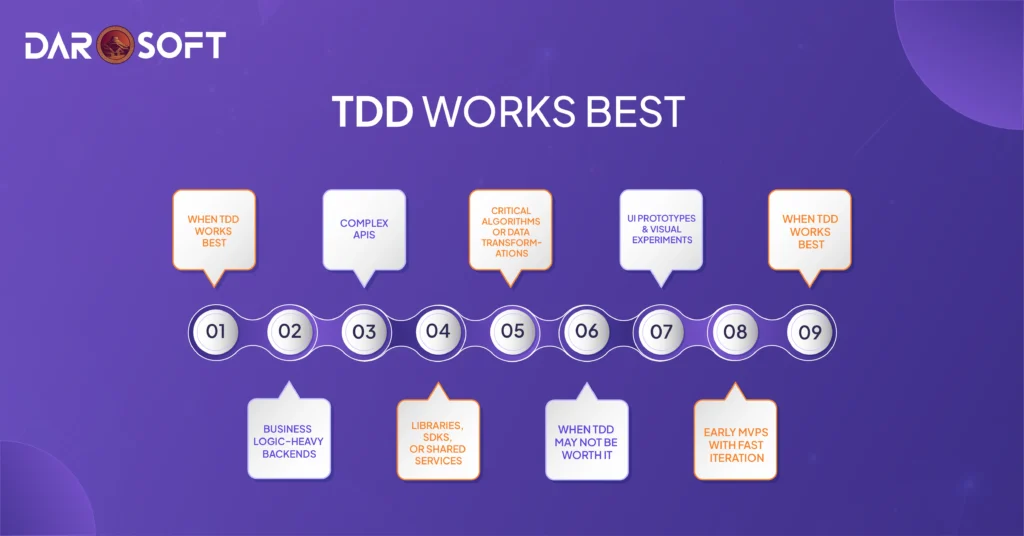
When TDD Works Best
TDD thrives in environments where stability, clarity, and correctness are critical:
Business Logic–Heavy Backends
When you’re dealing with core systems (e.g., billing, authentication, workflows), TDD helps define rules up front and catch subtle edge cases before they cause major issues.
Complex APIs
For APIs with strict contracts, expected inputs/outputs, or chained behaviors, TDD ensures reliability and gives you a safety net during iteration or refactoring.
Libraries, SDKs, or Shared Services
When building reusable components that others depend on, TDD gives you confidence in versioning, backward compatibility, and clear behavior definitions through tests-as-documentation.
Critical Algorithms or Data Transformations
Whether it’s recommendation logic, search ranking, or financial calculations, TDD ensures logic is mathematically sound and doesn’t silently break during optimization.
When TDD May Not Be Worth It
While TDD is valuable, it can add unnecessary friction in projects that are changing rapidly or have uncertain requirements:
UI Prototypes & Visual Experiments
If you’re exploring UI layouts, animations, or interaction patterns, things are likely to change frequently. In this case, writing tests first can slow creativity without much payoff.
Early MVPs with Fast Iteration
When speed-to-market is the top priority and core functionality is still being validated, the overhead of TDD might outweigh the benefits. A lighter test strategy (e.g., smoke tests or manual validation) might be more practical.
Highly Visual Interfaces (e.g., drag-and-drop builders)
Some frontends are better tested with end-to-end tools (like Cypress or Playwright) instead of pure unit tests. TDD can still play a role behind the scenes, but UI-heavy code often benefits more from visual testing.
Common Misconceptions About TDD
Test-Driven Development (TDD) often gets a bad rap, especially from teams unfamiliar with its long-term benefits. Let’s debunk a few of the most common myths with some practical realities:
“It Slows Development Down”
Reality: TDD may feel slower at first, but it saves time over the full lifecycle.
It reduces time spent debugging, rewriting, or reverse-engineering vague requirements.
With fewer regressions and cleaner code, teams spend more time shipping features and less time fixing bugs.
Going slower to go faster is the TDD advantage.
“It’s Only for Perfectionists”
Reality: TDD isn’t about being perfect. It’s about being intentional.
TDD helps you write only the code you need.
It keeps you focused on solving the right problem, with just enough implementation to make the test pass.
It’s more about clarity and control than polish.
Think of it as guardrails, not gold-plating.
“You Don’t Need Tests If You’re Experienced”
Reality: Experience doesn’t make you immune to edge cases, regressions, or human error.
Even seasoned developers forget logic paths, misinterpret specs, or make changes that unintentionally break features.
TDD adds confidence to refactor freely, collaborate safely, and validate assumptions early.
TDD isn’t a crutch. It’s a practice used by top developers to move fast without fear.
TDD in Action: A Simple Python Example
Let’s walk through a basic TDD cycle using Python to build a small function: is_even(n) — it returns True if a number is even, False if it’s odd.
We’ll follow the Red → Green → Refactor cycle.
Step 1: Write a Failing Test (Red)
python
# test_math_utils.py
from math_utils import is_even
def test_is_even_returns_true_for_even_number():
assert is_even(4) is True
The test defines the behaviour.
It fails because the function is_even() doesn’t exist yet.
Step 2: Make the Test Pass (Green)
Now write just enough code to make it work.
python
# math_utils.py
def is_even(n):
return n % 2 == 0
Now the test passes.
No optimisations, no extras—just what’s needed.
Step 3: Refactor (With Tests Still Passing)
Let’s clean up a bit, maybe we add a second test and validate input:
python
# test_math_utils.py
def test_is_even_returns_false_for_odd_number():
assert is_even(5) is False
Now update the function to be more robust (optional):
python
def is_even(n):
if not isinstance(n, int):
raise ValueError(“Input must be an integer”)
return n % 2 == 0
Final Test Suite Output
$ pytest
test_is_even_returns_true_for_even_number
test_is_even_returns_false_for_odd_number
What This Example Demonstrates
Red: You define the contract before implementation.
Green: You focus only on passing the test.
Refactor: You improve structure confidently with safety nets in place.
Tools & Frameworks with TDD
Test-Driven Development becomes far more effective and enjoyable when paired with the right tools. Here’s a quick guide to essential libraries and frameworks that support TDD across popular languages and environments:
Python
pytest: A lightweight, expressive test runner with rich plugins and readable syntax.
Ideal for writing small tests first and scaling up your test suite.unit-test: Python’s built-in testing framework. Great for getting started with no additional setup.
bash
pip install pytest
JavaScript / TypeScript
Jest: A popular all-in-one testing framework by Meta. Includes assertions, mocks, and snapshot testing.
Mocha: Flexible test runner often paired with Chai (assertions) and Sinon (mocks).
Vitest: A modern, blazing-fast test runner designed for Vite and frontend frameworks like Vue or React.
bash
npm install –save-dev jest
Java
JUnit: The gold standard for Java testing. Seamlessly integrates with most IDEs and build tools (Maven, Gradle).
Pair it with Mockito for mocking and verifying interactions in your TDD cycle.
xml
<!– Maven example –>
<dependency>
<groupId>org.junit.jupiter</groupId>
<artifactId>junit-jupiter</artifactId>
<version>5.9.2</version>
<scope>test</scope>
</dependency>
CI/CD Integration Tools
Once you’ve written tests, run them automatically on every commit or pull request:
GitHub Actions: Native CI/CD for GitHub, perfect for test automation in TDD pipelines.
CircleCI: Fast, flexible cloud-based CI service with great Docker and parallelism support.
Travis CI: Simple YAML-based config, commonly used for open source projects.
Bonus Tools for TDD
Test coverage:
coverage.py (Python), nyc (JavaScript), or JaCoCo (Java)
Mocking/stubbing:
unittest.mock, Sinon.js, Mockito
Watch mode:
Run tests automatically as you write code (–watch in Jest or Vitest)
Conclusion
Test-Driven Development (TDD) isn’t a magic trick or a coding hack; It’s a discipline. It requires patience, intention, and a willingness to rethink how you approach writing code. But the payoff? It’s real.
Teams that commit to TDD often ship fewer bugs, maintain cleaner code-bases, and feel more confident making changes, even late in the product cycle. By writing tests first, you clarify your goals, reduce uncertainty, and design software that’s easier to understand, extend, and debug.