- Written by: Hummaid Naseer
- July 1, 2025
- Categories: Custom Software & App Development
How you manage the process is just as critical as what you’re building. The right project management methodology can align teams, streamline communication, manage risk, and accelerate delivery. The wrong one? It can cause delays, scope creep, misalignment, and even outright failure.
From startups racing to launch MVPs to enterprises navigating complex stakeholder needs, there’s no one-size-fits-all solution. Agile may offer speed and adaptability, but waterfall might be better for fixed-scope compliance projects. Hybrid models and custom frameworks are increasingly common to address specific contexts and constraints.
Understanding Waterfall methodology
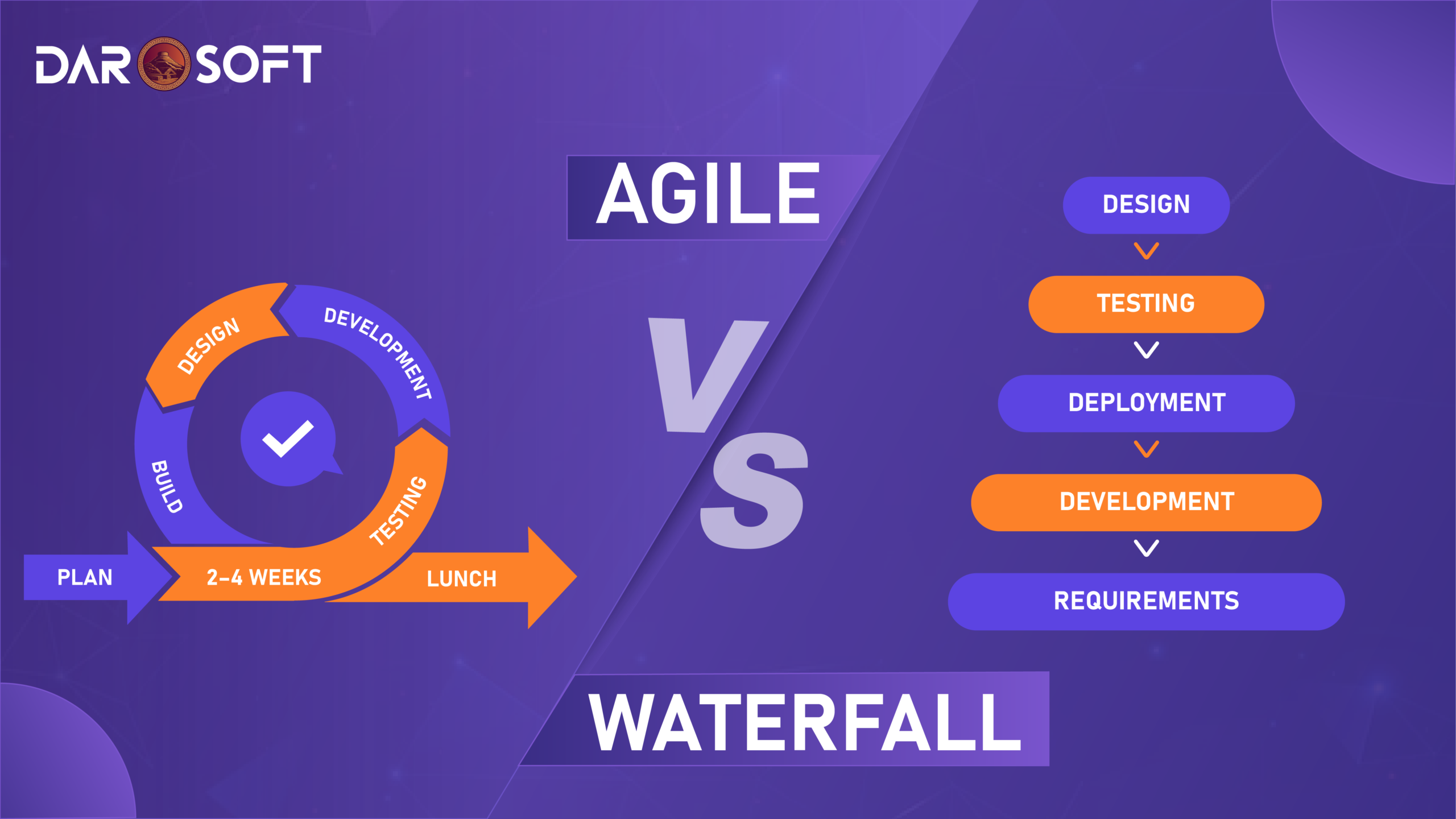
The Waterfall methodology is a traditional, linear project management approach where each phase of the project requirements, design, development, testing, and deployment flows in a strict, sequential order. You complete one phase before moving on to the next, with little room for changes once the process is underway.
This method is best suited for projects with well-defined, fixed requirements, such as government systems, compliance-driven software, or projects with little expected change during development. It offers predictability, clear documentation, and structured timelines, but lacks the flexibility to adapt quickly to evolving needs or feedback mid-project.
In short, Waterfall works when you need certainty. But in fast-moving digital environments, that certainty can come at the cost of agility.
Understanding Agile methodology
Agile project management is an iterative and adaptive approach designed to deliver value quickly and respond to change effectively. Instead of following a rigid sequence, Agile breaks work into smaller cycles called sprints or iterations, allowing teams to continuously plan, build, test, and refine the product.
Agile emphasises collaboration, transparency, customer feedback, and continuous improvement. Cross-functional teams work closely with stakeholders to prioritise features, respond to real-time input, and make incremental progress ensuring the final product aligns with evolving user and business needs.
It’s ideal for complex, fast-moving digital projects where flexibility, speed, and stakeholder engagement are critical such as SaaS platforms, mobile apps, or innovation-driven initiatives.
Agile vs Waterfall Key Differences
Aspect | Waterfall | Agile |
Planning | Extensive planning upfront; detailed requirements defined early | High-level planning upfront; detailed planning done iteratively |
Execution | Sequential phases (design → build → test → deploy) | Iterative sprints with continuous design, development, and testing |
Client Involvement | Minimal after initial requirements gathering | Ongoing collaboration and feedback throughout the project |
Change Management | Difficult to accommodate changes once development begins | Designed to embrace and adapt to changes quickly |
Delivery Timelines | One final delivery at the end of the project | Incremental deliveries in short cycles (e.g., every 2–4 weeks) |
Budget Control | Easier to estimate upfront; changes may increase costs | A flexible budget requires regular review and re-prioritisation |
When Waterfall Works Best
Waterfall is ideal for projects with fixed scopes, strict budgets, and regulatory demands, as its structured phases and thorough documentation align well with procurement and audit processes. For example, a government agency hiring a software company to build a legally mandated compliance reporting system with fixed requirements, a hard deadline, and multiple security audits would benefit from Waterfall’s predictable and controlled approach.
Phase | Description |
1. Requirements | All project needs are gathered and documented in detail upfront. No development begins until the client signs off. This includes report formats, compliance rules, data sources, and expected outputs. |
2. Design | Technical planning of the system architecture, database structure, and user interfaces. This phase translates requirements into blueprints for developers, focusing on performance, security, and scalability. |
3. Development | The actual coding begins based on the approved design documents. Teams build the complete system in one pass, without introducing scope changes or reworking requirements midstream. |
4. Testing | A full QA cycle occurs after development is complete. Includes functional, performance, and compliance testing to ensure the system works as intended and meets legal or regulatory standards. |
5. Deployment | The system is deployed to production. Final deliverables—like user documentation, training, and maintenance plans—are provided. Post-launch changes require formal change requests. |
This structure ensures accountability, predictability, and regulatory alignment, making it especially suitable for projects in the public sector or compliance-heavy industries.
When Agile Is the Smarter Choice
Agile is well-suited for startups that face limited resources and high uncertainty, as it enables rapid idea testing, quick pivots, and early user feedback without heavy upfront investment. It’s especially effective for building Minimum Viable Products (MVPs), allowing teams to launch core features quickly, learn from real users, and iterate in short cycles accelerating time-to-market and reducing risk.
Agile Phase | Description |
1. Product Backlog | A dynamic, prioritised list of features, enhancements, and fixes maintained by the Product Owner. Items are written as user stories and evolve throughout the project. |
2. Sprint Planning | A collaborative meeting where the team selects which backlog items to complete during the upcoming sprint (typically 1–4 weeks). Scope is based on team capacity and priorities. |
3. Sprint Execution | The development team works on selected tasks during the sprint. Includes design, coding, testing, and documentation in an iterative, time-boxed cycle. |
4. Daily Standups | Short (15-minute) daily meetings where team members share progress, blockers, and plans. Promotes transparency and rapid issue resolution. |
5. Sprint Review | Held at the end of each sprint to demo completed work to stakeholders. Provides an opportunity for feedback and realignment based on outcomes. |
6. Sprint Retrospective | A team-only meeting to reflect on what went well, what didn’t, and how to improve in the next sprint. Drives continuous improvement and team cohesion. |
In Agile, these phases are repeated continuously in short cycles, enabling rapid iteration, tight feedback loops, and the flexibility to adapt the product as user needs and market conditions evolve.

The Rise of Agile-Waterfall Mashups
In today’s complex project environments, many teams are moving beyond rigid “Agile vs. Waterfall” thinking and embracing hybrid methodologies—custom blends that combine the predictability of Waterfall with the flexibility of Agile. This mashup approach reflects the reality that business needs, stakeholder expectations, and product complexity often require a bit of both worlds.
What Does a Hybrid Model Look Like?
Agile Sprints Within a Waterfall Framework:
Teams follow Agile development cycles (sprints, standups, retros) but operate under a Waterfall-style contract that mandates fixed milestones, budgets, or deliverables. This is common in government or enterprise projects that require formal documentation and gated approvals.Waterfall for Planning, Agile for Execution:
High-level planning (e.g., requirements gathering, budgeting, architecture) follows a traditional Waterfall approach, while the actual development and testing are iterative and Agile-driven, allowing for flexibility without sacrificing structure.Stage-Gated Agile:
Agile teams operate within defined phases or “gates” (e.g., prototype → beta → launch), with executive reviews and funding decisions made at each gate mixing agility in execution with accountability in oversight.
How to Decide: Key Factors to Consider
Selecting between Agile, Waterfall, or a hybrid approach isn’t just about following trends—it’s about aligning your project methodology with your goals, constraints, and team dynamics. Here’s how to evaluate which model fits best based on critical decision factors:
Decision Factor | Best for Waterfall | Best for Agile | Best for Hybrid |
Stakeholder Involvement | Low involvement after kickoff; sign-offs at major milestones | High, ongoing collaboration and feedback are needed | Moderate involvement; checkpoints at key phases + agile execution |
Time-to-Market | Longer timelines, less flexibility for changes | Fast, iterative delivery is ideal for early releases and MVPs | Structured deadlines with room for iterative improvement |
Team Size & Maturity | Suited for larger, formal teams with defined roles | Ideal for small to mid-sized, cross-functional, autonomous teams | Great for mixed teams or scaling orgs with uneven Agile adoption |
Budget Structure | Fixed budget and scope agreed upfront | Flexible budget that evolves with scope and priorities | Fixed phases with variable execution budgets |
Product Complexity | Low-change, clearly defined deliverables (e.g., compliance tools) | Complex, evolving products that benefit from feedback and iteration | Complex programs requiring coordination across Agile and Waterfall teams |
Quick Rule of Thumb
Choose Waterfall for predictability, documentation, and compliance-heavy projects.
Choose Agile for innovation, speed, and customer-centric products.
Choose Hybrid when you need to satisfy both structure and adaptability, especially in multi-stakeholder or regulated environments.
Conclusion
Finalising the right project management methodology isn’t just a procedural decision; it’s a strategic one that directly impacts speed, quality, collaboration, and adaptability. While Waterfall offers structure and predictability for fixed-scope, high-compliance projects, Agile thrives in fast-moving, feedback-driven environments where innovation and responsiveness are key. And increasingly, hybrid models provide a flexible middle ground, combining the strengths of both approaches to suit complex, real-world conditions.
The smartest teams don’t force-fit a framework. They choose (or blend) methodologies that align with their goals, team dynamics, and customer needs. Because in today’s digital landscape, the way you work can be just as important as what you build.