- Written by: Hummaid Naseer
- September 1, 2025
- Categories: AI Tools & Frameworks
Machine learning might sound like something out of a sci-fi movie, but it’s quietly powering a huge part of your everyday life. It’s the reason Netflix knows what you’ll want to watch next, why your inbox rarely sees spam, and how banks detect fraud in real time. At its core, machine learning (ML) is about teaching computers to learn from data without being explicitly programmed every step of the way.
Traditional programming just can’t keep up with the complexity and volume of decisions businesses need to make. That’s where ML comes in. It helps systems adapt, improve, and make smarter choices over time. Whether you’re a developer, a business owner, or just someone curious about the future, understanding machine learning is no longer optional; it’s essential.
What Is Supervised Learning?
Supervised learning is a core branch of machine learning where the algorithm learns from labeled data, that is, data that already comes with the correct answers (also called targets or outputs).
You’re essentially “supervising” the learning process, like a teacher showing a student examples with the right answers, so they can learn to generalize to new situations.
A Simple Analogy: Learning With Flashcards
Imagine you’re helping a child learn to recognize animals using flashcards. One card has a picture of a dog and the word “dog.” Another has a cat and says “cat.” Over time, the child starts recognizing patterns for shape, ears, and color, and learns to correctly name new animals they’ve never seen before.
That’s exactly how supervised learning works:
You provide examples (input data) and the correct answers (labels).
The model finds patterns in the input that lead to the right output.
Eventually, it can make accurate predictions on new, unlabeled data.
Examples
Here’s how supervised learning shows up in your daily life:
Use Case | Input | Label / Prediction |
Spam detection | Email text, sender, subject line | “Spam” or “Not Spam” |
Image classification | Pixels of an image | “Cat” or “Dog” |
House price prediction | Square footage, location, # of rooms | Price of the house |
Medical diagnosis | Symptoms, test results | Disease or condition diagnosed |
Sentiment analysis | Product review text | “Positive” or “Negative” |
How Supervised Learning Works: Step by Step
Collect Labeled Data
You start with a dataset where each example has both:
Input features – What the model sees (e.g., a picture, email text, numbers)
Labels – The correct answer (e.g., “spam” or “not spam”)
Split the Dataset
Training Set – Used to teach the model.
Test Set – Used to evaluate how well the model learned.
Train the Model
The model takes the inputs and tries to predict the labels. At first, it’s inaccurate. But with each example, it compares its prediction to the actual label and adjusts its internal parameters (using algorithms like gradient descent and loss functions).
Validate and Test
Once trained, the model is evaluated on new, unseen data to check how well it generalizes, not just memorizes.
Types of Problems Solved with Supervised Learning
Classification – Predicting a category
Example: Is this tumor benign or malignant?Regression – Predicting a continuous value
Example: What will the temperature be tomorrow?
Benefits of Supervised Learning
Produces highly accurate models (if good data is available)
Great for real-world business applications
Easy to understand and implement for many tasks
Limitations
Requires a large, labeled dataset (which can be expensive or time-consuming to create)
Doesn’t work well with ambiguous or unstructured data unless it’s preprocessed
What Is Unsupervised Learning?
Unsupervised learning is a type of machine learning where the model works with unlabeled data, meaning the data doesn’t come with answers or categories. Instead of being told what to look for, the model tries to find hidden patterns or structure in the data on its own.
Think of it like exploring a new city without a map, you start to recognize neighborhoods, group similar places together, and figure out patterns from observation.
Real-World Examples
Use Case | What It Does |
Customer segmentation | Groups customers based on behavior (e.g., buying habits, location, spending) |
Market basket analysis | Finds products frequently bought together (“Customers who bought X also bought Y”) |
Anomaly detection | Identifies unusual patterns in network traffic, financial data, or sensor input |
Content recommendation | Suggests content based on usage patterns and clusters of interest |
Document/topic clustering | Group articles or text by underlying topics without predefined categories |
How Unsupervised Learning Works
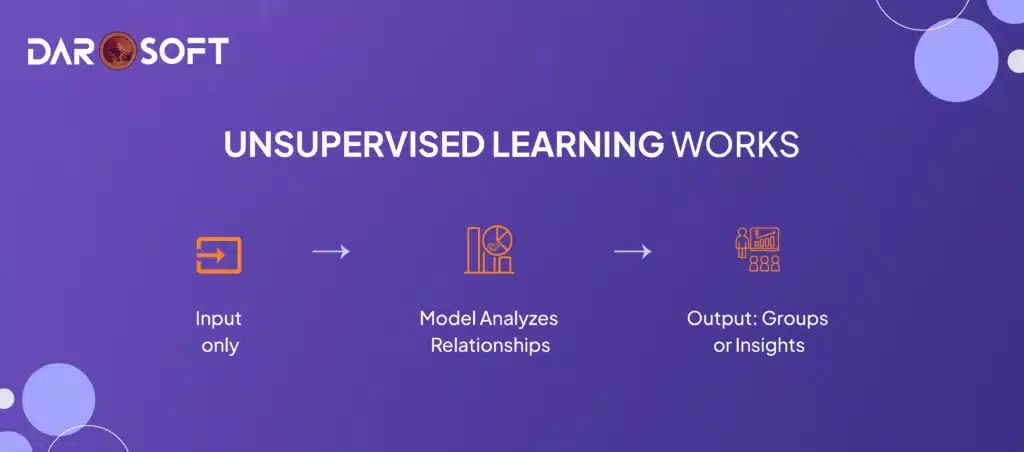
Input Only
You feed the model data, lots of it, but no labels or outcomes.
Model Analyses Relationships
The model analyses the data to:
Find similarities
Group data points that behave alike
Highlight structures or patterns that humans might not immediately see
Output: Groups or Insights
The result is often:
Clusters (for grouping similar items)
Associations (for finding common combinations)
Anomalies (for detecting outliers)
Types of Unsupervised Learning Tasks
Clustering
Goal: Group similar data points together.
Example: Segmenting online shoppers into behaviour-based groups (frequent buyers, bargain hunters, etc.)
Common algorithms: K-Means, DBSCAN, Hierarchical clustering
Association
Goal: Discover rules that describe how data items relate to each other.
Example: Customers who buy coffee also often buy croissants.
Common algorithms: Apriori, Eclat
Dimensionality Reduction
Goal: Simplify complex data by reducing the number of features while retaining meaningful information.
Example: Visualising high-dimensional customer behaviour on a 2D chart.
Common techniques: PCA (Principal Component Analysis), t-SNE
Analogy: Sorting Socks Without Labels
Imagine dumping a pile of mixed socks on the floor. You don’t know which belongs to whom, but you can:
Group them by colour
Pair similar patterns
Separate unusual ones (like a single red sock in a sea of black)
That’s what unsupervised learning does it makes sense of data without needing explicit answers.
Benefits
Great for exploring new datasets
Helps uncover patterns humans might miss
Useful when labeled data isn’t available
Challenges
Harder to validate the results, no “correct” answers to compare to
Results can be ambiguous or less interpretable
Sensitive to noise and data quality
Supervised vs. Unsupervised Learning: In-Depth Comparison
Feature | Supervised Learning | Unsupervised Learning |
Data Type | Uses labeled data – each input comes with a corresponding correct output or label (e.g., “spam” or “not spam”). | Uses unlabeled data – no predefined outputs; the model must infer the structure or relationships on its own. |
Objective | To learn a mapping from inputs to outputs, so the model can make accurate predictions on new data. | To explore the data and find hidden patterns, groupings, or structures without predefined labels. |
Output | Predictive outputs – such as a category label or numerical value. | Descriptive outputs – such as clusters, association rules, or reduced dimensions. |
Learning Style | Guided learning: like a student learning with an answer key. | Self-learning: like exploring a library without knowing exactly what you’re looking for. |
Feedback Mechanism | Yes – the model uses error (difference between prediction and actual label) to improve over time (e.g., via gradient descent). | No explicit feedback – there is no “correct answer” to compare against; the model organises data based on structure alone. |
– Linear Regression – Logistic Regression – Decision Trees – Support Vector Machines (SVM) – Neural Networks | – K-Means Clustering – Hierarchical Clustering – DBSCAN – Principal Component Analysis (PCA) – Autoencoders | |
Use Case Examples | – Email spam detection – Disease diagnosis from medical images – House price prediction – Sentiment analysis on reviews | – Customer segmentation – Market basket analysis (frequently bought together items) – Fraud or anomaly detection – Organising untagged photo collections |
Evaluation Metrics | Accuracy, Precision, Recall, F1 Score, ROC-AUC | Silhouette Score, Davies–Bouldin Index, Cluster Cohesion/Separation |
Human Involvement | Requires more upfront work to label data correctly. | Requires more interpretation after ward to understand and label discovered groups. |
Difficulty Level | Easier to evaluate and validate since outcomes are known. | Harder to validate; requires domain knowledge to interpret results and assess value. |
When to Use Which?
Supervised Learning
Use supervised learning when:
You have a specific prediction goal like forecasting sales, detecting spam, or classifying images (e.g., cat vs. dog).
You have access to labeled data where each example includes both the input and the correct output.
You want to build predictive models that learn from past data and apply that learning to future or unseen data.
You can measure accuracy using known outcomes to refine your model (e.g., through cross-validation).
Example: You want to predict which customers are likely to churn based on their usage history and you have historical churn labels. Supervised learning fits perfectly.
Unsupervised Learning
Use unsupervised learning when:
You want to explore the structure of your data and discover hidden relationships, patterns, or groupings.
You don’t have labeled outputs, meaning no “correct answers” for each data point.
You need pre-processing or insights before applying other models, like reducing dimensionality or grouping similar users.
You’re seeking data-driven discovery to inform strategy or segment your audience.
Example: You have a large dataset of customer behaviour, but no labels. You want to find natural groupings to tailor marketing campaigns. Unsupervised learning is the way to go.
Semi-Supervised and Reinforcement Learning (Honorable Mentions)
Semi-Supervised Learning
Definition: A hybrid approach that falls between supervised and unsupervised learning. It uses a small amount of labeled data combined with a large amount of unlabeled data to improve learning efficiency.
Why It Matters:
Labeling data is expensive and time-consuming.
Semi-supervised models can achieve high accuracy with minimal labeled input.
Real-World Example:
A photo platform like Google Photos may manually label only a few images as “dog” or “cat,” then use those to help the system learn from millions of unlabeled images.
When to Use It:
When you don’t have enough labeled data to train a robust supervised model but you do have a lot of raw, unlabeled data.
Reinforcement Learning (RL)
Definition: A type of learning where an agent learns by interacting with an environment, making decisions, and receiving rewards or penalties based on its actions.
Why It Matters:
It powers some of the most advanced systems, from self-driving cars to game-playing AIs (like AlphaGo).
RL models improve over time by maximising long-term reward, not just immediate outcomes.
Real-World Example:
A robot learning to walk or a trading bot adjusting strategies based on market rewards and losses.
When to Use It:
When there’s a clear goal, an environment to explore, and consequences (positive or negative) tied to every action taken by the model.
Final Thoughts
Many modern systems blend multiple approaches depending on the stage of the project, the quality of data, and what you’re trying to achieve.
You might use unsupervised learning to uncover patterns in raw data…
Then apply supervised learning to predict outcomes from those patterns.
Or use semi-supervised methods to train better models with limited labeled data.
And in some dynamic environments, reinforcement learning might be the key to long-term optimisation.
The best approach depends on your data, objectives, and how much human input is feasible. Rather than choosing one method, think of these techniques as tools in a growing ML toolkit, each suited for different jobs, often working best when used together.