- Written by: Hummaid Naseer
- November 6, 2025
- Categories: Tech Stack
Many teams set out with brilliant ideas, only to lose months (or even years) developing products that fail to meet real user needs. The problem isn’t effort, it’s direction. True success in product development lies in building smarter, not harder.
Why Traditional Product Development Often Fails
Traditional development approaches often rely on long planning cycles, heavy documentation, and a “build first, test later” mentality. Teams spend significant time perfecting a product’s features before ever showing it to users, only to discover, too late, that the solution misses the mark.
This waterfall-style process leads to:
Costly rework due to poor market validation
Products overloaded with unused features
Long delays before any real user feedback
High risk of failure at launch
How the Lean Startup Methodology Revolutionised Innovation
Enter the Lean Startup Methodology, introduced by Eric Ries, which transformed how modern products are built. Its core philosophy is simple: learn fast, build less, and validate continuously.
Instead of relying on assumptions, Lean Startup encourages teams to:
Build a small, testable version of the idea.
Measure how real users respond.
Learn what works and pivot or persevere accordingly.
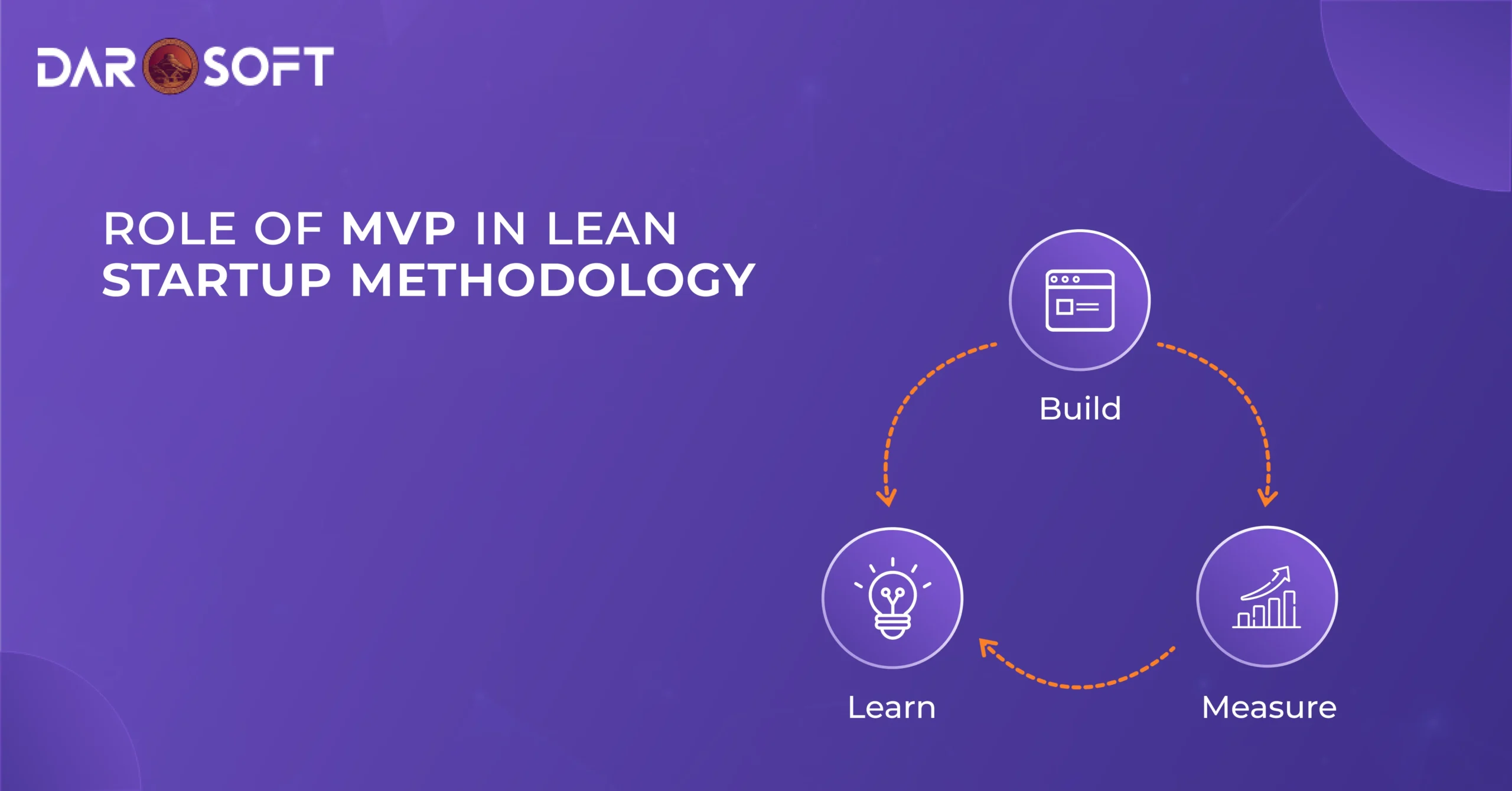
This Build–Measure–Learn feedback loop empowers startups and enterprises alike to minimise waste, shorten development cycles, and align innovation with real-world demand.
Where the Minimum Viable Product (MVP) Fits in the Equation
At the heart of the Lean Startup approach lies the Minimum Viable Product (MVP), the most efficient way to test your business idea in the real market.
An MVP is a functional, minimal version of your product built with just enough features to deliver value and gather feedback from early users.
It’s not about cutting corners. It’s about validating direction before scaling. The MVP helps teams answer critical questions:
Do users find value in the core offering?
Is there real demand for the solution?
What should we improve or pivot next?
By focusing on learning rather than perfection, the MVP bridges the gap between vision and validation, ensuring that engineering effort and business goals move in sync.
Understanding the Lean Startup Framework
The Lean Startup Framework reshaped modern product development by shifting the focus from building more to learning faster. It rejects the idea that success depends on flawless execution of a fixed plan; instead, it emphasises experimentation, feedback, and adaptation. At its core, Lean Startup is about reducing uncertainty and discovering what customers truly want before investing heavily in development.
Core Principles: Build – Measure – Learn
At the heart of Lean Startup lies a simple yet powerful loop: Build → Measure → Learn.
Build: Create a Minimum Viable Product (MVP), a simplified version of your idea that allows you to test key hypotheses.
Measure: Collect real-world data and feedback on how users interact with it.
Learn: Use those insights to validate or refute assumptions, and decide whether to pivot (change direction) or persevere (keep improving).
This feedback-driven cycle ensures that every development decision is grounded in evidence, not guesswork.
Focus on Validated Learning Instead of Assumptions
Traditional planning assumes you already know your customers and their needs. The Lean Startup approach flips that logic; it assumes you don’t.
The goal is to achieve validated learning: confirming, through data and user behaviour, that your product solves a real problem worth paying for.
Every feature, design choice, and marketing decision should serve this goal. If it doesn’t generate measurable learning, it’s likely a waste. By embracing this mindset, teams replace risky assumptions with proven insights, reducing the chance of failure at scale.
Continuous Iteration as the Key to Sustainable Growth
Lean Startup isn’t a one-time experiment; it’s an ongoing process of continuous iteration.
Each loop of building, measuring, and learning leads to a stronger, more aligned product. This constant adaptation helps teams:
Stay responsive to changing market needs
Optimise resources and reduce waste
Build products that evolve with real user behaviour
In essence, continuous iteration fuels sustainable growth. Instead of betting everything on a big launch, Lean Startup teams grow through small, validated wins, learning what works and scaling it with confidence.
What Exactly Is an MVP?
A Minimum Viable Product (MVP) is not just a smaller or incomplete version of your final product. It’s the simplest functional version that allows your team to learn from real users as quickly as possible. The goal of an MVP isn’t perfection; it’s validation, testing your assumptions about user needs, market demand, and product value with minimal effort and resources.
Definition
At its core, an MVP is a learning tool. It’s built with just enough features to solve a core problem for early adopters and generate meaningful feedback.
This feedback then guides what to improve, add, or discard in future iterations.
Unlike a prototype (which simulates functionality), an MVP is a working product, something users can actually interact with, even if it’s limited in scope or polish.
Not Just a “Small Product”: But a Learning Experiment with Code
An MVP isn’t about cutting corners; it’s about testing hypotheses through real usage.
Every feature you include should serve a learning purpose. If it doesn’t help you answer a key question, like “Will users pay for this?” or “Does this workflow make sense?” it doesn’t belong in your MVP.
Think of it as an experiment with code: you’re not building to impress; you’re building to learn.
This mindset keeps development focused, lean, and purposeful, ensuring that every hour of engineering effort drives insight, not just output.
Examples: Landing Pages, Concierge MVPs, Single-Feature Apps
An MVP can take many forms depending on what you’re testing:
Landing Page MVP: A simple page that describes your product idea and measures interest through sign-ups or clicks before writing any code.
Concierge MVP: Delivering your service manually to early users (instead of through automation) to validate the concept before scaling.
Single-Feature App: Building only the most essential function. For example, a basic task manager that tests one key workflow before expanding into a full productivity suite.
Each approach helps you validate different assumptions. Whether about user interest, behaviour, or willingness to pay, without over committing to a full build.
An effective MVP doesn’t aim to be perfect. It aims to teach you something vital. Once you learn what truly matters to your users, you can evolve the product confidently, guided by real evidence instead of guesswork.
The Purpose of an MVP in Lean Startup
In the Lean Startup methodology, the Minimum Viable Product (MVP) serves as the bridge between idea and evidence. It’s the practical tool that turns assumptions into insights and uncertainty into progress. Instead of guessing what users might want, teams use an MVP to test real behaviour learning what works, what doesn’t, and why before investing heavily in development.
Solution Fit and Market Demand
Every startup begins with a hypothesis: We believe this solution will solve this problem for this audience.
The MVP’s purpose is to validate or invalidate that hypothesis as quickly as possible.
By releasing a minimal, working version of the product to real users, teams can observe:
Do users actually experience the problem we’re trying to solve?
Does our solution create measurable value or improvement?
Is there enough interest or demand to justify further investment?
In this way, the MVP becomes a learning experiment, revealing whether the core idea is worth pursuing or needs to pivot in a new direction.
Minimising Waste in Time, Effort, and Resources
Traditional development often leads to overbuilding, creating complex systems and features before proving their necessity.
An MVP counters this by focusing only on what’s essential to test the hypothesis.
This lean approach:
Reduces unnecessary coding and design effort
Conserves budget for validated improvements
Speeds up time-to-insight, not just time-to-launch
The result is maximum learning with minimum waste, allowing teams to stay nimble and adaptive instead of locked into costly, rigid plans.
Collecting Real User Data to Guide Future Development
The MVP is not a static release. It’s a feedback engine. By observing how users interact with it, teams gain concrete data about what truly matters to their audience.
Metrics like engagement rates, drop-offs, and feature usage reveal where to focus next.
This user-driven learning ensures that every iteration, every added feature, refinement, or pivot, is based on evidence, not assumption.
Turning Uncertainty Into Measurable Insight
At its core, the MVP transforms uncertainty into knowledge. Instead of treating unknowns as risks, it makes them testable.
Each experiment, whether it succeeds or fails, brings teams closer to product–market fit through measurable, actionable insights.
How MVP Drives the Build–Measure–Learn Cycle
The Minimum Viable Product (MVP) is the heartbeat of the Lean Startup framework. It’s the practical engine that keeps the Build–Measure–Learn cycle in motion, turning bold ideas into data, and data into direction.
Instead of relying on intuition or assumptions, the MVP ensures that every product decision is guided by evidence gathered from real users.
Develop the Minimal Version to Test a Key Assumption
The cycle begins with building, but not in the traditional sense.
Rather than constructing a full-featured product, teams focus on the smallest version that can effectively test a core assumption. such as:
Will users actually engage with this feature?
Does this workflow solve their problem better than existing solutions?
Will people pay for this offering?
The goal is to build quickly, with purpose, and to learn fast. Every element of the MVP should exist to validate (or invalidate) one hypothesis.
Measure: Collect Meaningful Metrics
Once the MVP is live, the next step is to measure what matters. Data replaces opinions, and the right metrics help teams understand whether their assumptions hold.
Key performance indicators may include:
Engagement: How often are users interacting with the product?
Retention: Do they come back after their first use?
Conversion: Are they completing key actions (sign-ups, purchases, etc.)?
These metrics form the foundation for validated learning, providing clear signals about what’s working and where friction exists.
Decide Whether to Pivot or Persevere
The final step and arguably the most critical, is learning from the data.
Teams analyse user behaviour and outcomes to decide whether to:
Pivot: Change direction if assumptions were wrong or demand is weak.
Persevere: Continue refining and improving if results show promise.
Each loop through this process turns uncertainty into clarity, guiding smarter product decisions and aligning development with real-world evidence.
The Loop That Keeps Innovation Data-Driven, Not Opinion-Driven
The Build–Measure–Learn cycle isn’t a one-time activity. It’s a continuous loop that keeps innovation grounded in data, not ego.
Every iteration of the MVP fuels the next, creating a rhythm of experimentation, feedback, and improvement.
By repeating this process, teams ensure that progress isn’t based on assumptions or hierarchy, but on what users actually do and value.
Engineering MVPs: A Developer’s Viewpoint
From a developer’s perspective, building an MVP isn’t about cutting corners; it’s about delivering focused functionality fast while laying a foundation that can evolve. The challenge is to move quickly without creating technical debt that slows future growth.
Focusing on Core Functionality Over Polish
In an MVP, clarity trumps completeness. Developers should prioritise the single most important feature that validates the core value proposition.
Instead of investing time in perfect UI elements, animations, or edge-case handling, focus on:
A working solution to the primary user problem
A clean, stable architecture that allows easy iteration
Instrumentation and logging to capture learning data early
The goal is to prove the concept, not perfect the experience, yet the code-base should remain clear enough for quick scaling later.
Leveraging Development
Speed is a developer’s best ally in early-stage validation.
Modern tech stacks and platforms make it possible to ship MVPs in days, not months. For example:
Rapid frameworks: Next.js, Django, or Flutter for quick front-end and cross-platform builds
Open APIs & SDKs: Integrate payment, authentication, or analytics instead of building from scratch
Cloud services: Use AWS Amplify, Firebase, or Vercel for instant deployment and scalability
These tools reduce friction, helping teams focus on validating ideas instead of reinventing infrastructure.
Building Scalable Foundations
While speed is key, it’s equally important to think one step ahead. MVPs often succeed faster than expected, and scaling should not mean rewriting everything from scratch.
Developers can future-proof even lightweight MVPs by:
Using modular architectures and clear separation of concerns
Writing clean, minimal, and well-documented code
Employing version control and automated testing from day one
This ensures that when the MVP gains traction, it can grow without collapsing under technical debt.
Avoiding Over-Engineering While Maintaining Maintainability
The biggest pitfall for developers is building too much too soon. It’s tempting to architect for scale before the market even validates the need.
The sweet spot lies in lean engineering solutions that are:
Good enough to learn from, not overbuilt
Stable enough to iterate on, not disposable
Documented enough to onboard others, not over complicated
Common Mistakes When Building an MVP
Even though the Minimum Viable Product (MVP) is designed to simplify early development, many teams fall into traps that undermine its purpose. The goal of an MVP isn’t just to launch quickly. It’s to learn effectively. Avoiding these common mistakes can make the difference between wasted effort and meaningful progress.
Treating the MVP as a Prototype or Beta Version
An MVP is often misunderstood as a “fancier prototype” or an early-access beta release.
In reality, it’s neither.
A prototype tests design and usability.
Beta tests performance and stability.
An MVP tests value and demand.
When teams confuse these concepts, they end up polishing design details or debugging minor issues instead of validating whether the idea itself is worthy of existence.
Adding Too Many “Nice-to-Have” Features Early
Feature creep is one of the fastest ways to derail an MVP.
The “minimum” in MVP exists for a reason. To focus only on what’s essential for learning. Every additional feature adds complexity, delays the launch, and muddies the feedback.
Ask yourself: “Does this feature directly test a core assumption?”
If not, it probably doesn’t belong in the MVP.
Ignoring Qualitative Feedback and Real Usage Data
Numbers alone don’t tell the full story.
Teams often rely heavily on metrics sign-ups, clicks, or retention, while overlooking the qualitative feedback that reveals why users behave a certain way.
Talking to users, watching them interact with your product, and analysing their frustrations provides insights that no dashboard can replace.
An MVP succeeds only when data and empathy work together.
Failing to Iterate Quickly
Speed is the soul of the MVP process.
Building, measuring, and learning only matter if the cycle is short enough to respond to insights in real time.
Teams that wait months to update or over analyse data risk losing momentum and missing their window of opportunity.
Successful MVPs evolve through rapid iteration, where learning is constant and feedback drives every next step.
From MVP to Product-Market Fit
Once your MVP has validated the core assumptions, proving that real users find real value in your product. It’s time to move beyond experimentation. This phase is about turning early traction into sustainable growth, evolving from “learning mode” to “building a business.”
Scaling After Validation
Validation means your MVP has confirmed problem–solution fit, people not only use the product but are willing to pay, recommend, or rely on it.
The next challenge is scaling without losing agility. This involves:
Stabilizing infrastructure: Strengthening code, performance, and security for wider adoption
Expanding the team: Bringing in specialists (e.g., QA, UX, DevOps) as complexity grows
Streamlining processes: Implementing CI/CD, analytics, and support systems for repeatable success
Scaling isn’t about adding more features. It’s about supporting more users effectively while keeping the product lean and adaptable.
Transitioning from “Learning Mode” to “Growth Mode”
The MVP phase is driven by experimentation. Once validation occurs, teams shift their focus from “what should we build?” to “how do we grow it sustainably?”
This transition means:
Moving from hypothesis-driven development to data-driven optimization
Prioritizing user acquisition, retention, and monetization strategies
Building process maturity testing, documentation, and scalability practices
It’s a shift in mindset: from testing ideas to executing with confidence based on proven insights.
Using MVP Data to Prioritize Roadmap Features
Every decision in the growth phase should trace back to lessons learned during the MVP stage. The usage data, feedback, and pain points collected earlier form the foundation of your product roadmap.
Teams can now:
Identify the most requested or impactful features for the next releases
Eliminate or refine underperforming features
Use analytics to shape user journeys and engagement loops
In short, the MVP’s purpose was to learn now, and those learnings guide strategic scaling.
The Essence of Product-Market Fit
You’ve reached product-market fit when your product not only works but pulls users in faster than you can keep up. Signs include:
Consistent user growth and retention
Organic adoption through word-of-mouth
A clear understanding of your ideal customer
Reaching this point transforms your product from an experiment into a validated business, one ready to grow, scale, and dominate its niche.
MVP as the Core Engine of Lean Innovation
The Minimum Viable Product (MVP) is far more than a fast way to launch, it’s the core engine of lean innovation. It transforms how modern teams approach uncertainty, turning product development into a process of continuous discovery and validation.
MVPs Are Not Shortcuts
An MVP isn’t about cutting costs or skipping quality. It’s about being strategic with uncertainty, building just enough to learn what matters most.
Each MVP is a deliberate experiment, designed to answer critical questions:
Does this solution solve a real problem?
Will users adopt or pay for it?
What should we build next and why?
By treating every MVP as a learning opportunity, teams stay focused on outcomes instead of output.
Iteration Reduces Risk and Builds Confidence
Each iteration, every test, metric, and conversation chips away at the unknown.
What starts as an idea becomes evidence-backed knowledge.
Technical risks are uncovered early.
Market demand is proven through real data.
Teams gain confidence not from assumptions, but from results.
This compounding learning effect allows startups and enterprises alike to de-risk innovation and align engineering effort with real-world value.
The Scientific Method Applied to Modern Software Development
At its heart, the MVP approach mirrors the scientific method:
Form a hypothesis
Run an experiment
Observe and analyze results
Refine and repeat
By applying this mindset, teams turn product development into a measurable, iterative, and evidence-driven process.