- Written by: Hummaid Naseer
- August 13, 2025
- Categories: Services & Products
Too often, businesses don’t realize there’s a problem until it’s already cost them lost revenue, delayed operations, or frustrated customers. Whether it’s inaccurate data, outdated systems, or missed trends, the signs are usually there… just unnoticed until it’s too late.
Playing catch-up puts companies in reactive mode, scrambling to fix what’s broken instead of proactively optimizing performance. In today’s fast-moving landscape, that delay can mean the difference between scaling smoothly and falling behind.
The solution? Real-time visibility, smart alerts, and actionable insights that surface issues before they escalate. Because when your systems talk and your team listens, you shift from damage control to growth control.
What Reactive Inventory Management Looks Like
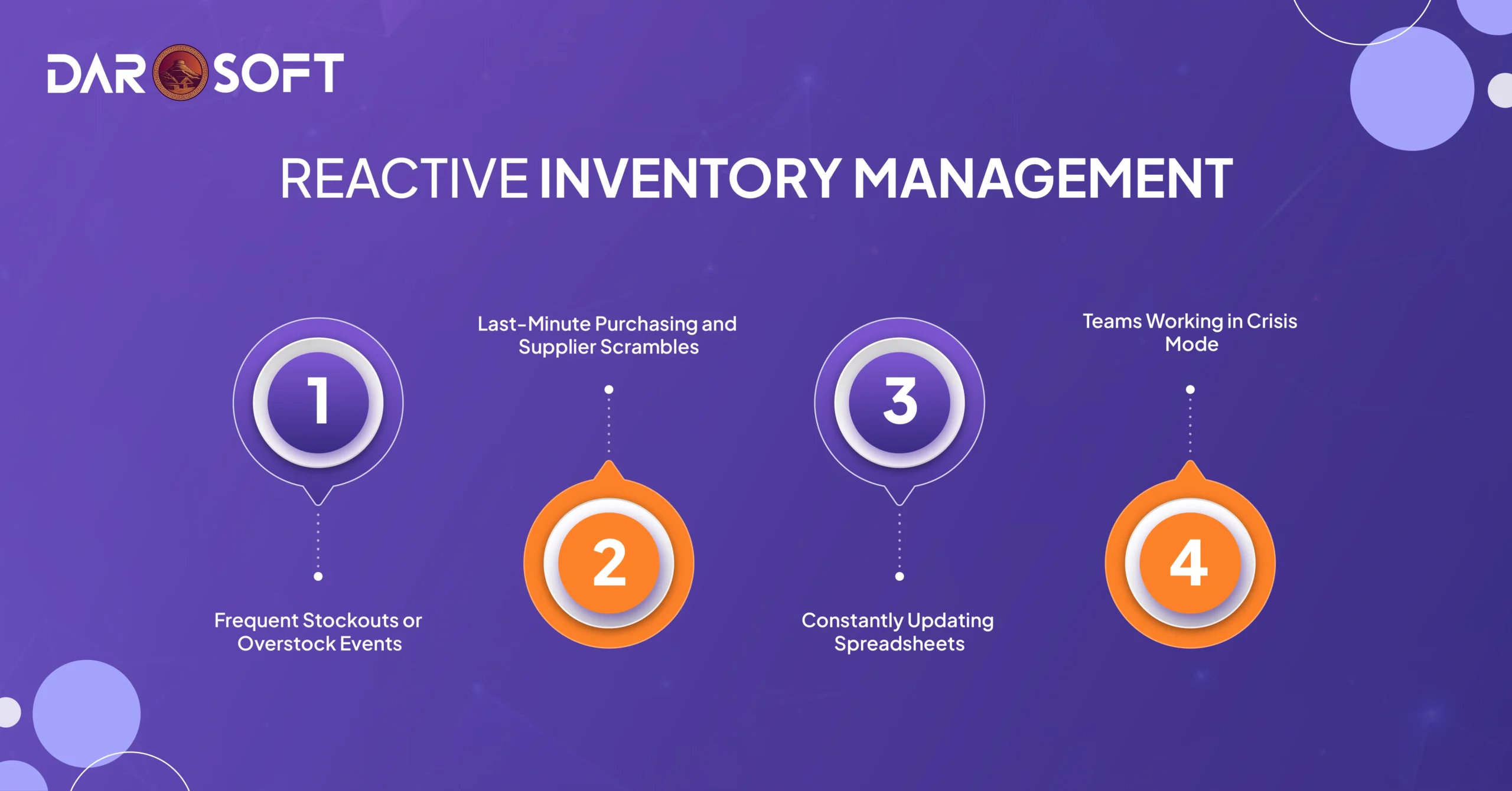
Reactive inventory management is akin to flying blind, constantly responding to problems rather than preventing them. Here’s how it typically shows up:
Frequent Stockouts or Overstock Events
You either don’t have enough inventory to fulfill orders, or you’re sitting on excess stock that ties up capital and takes up valuable shelf space.
Last-Minute Purchasing and Supplier Scrambles
Without accurate forecasts, procurement becomes a game of guesswork, leading to rushed orders, premium pricing, and strained vendor relationships.
Constantly Updating Spreadsheets
Manual tracking in Excel becomes the norm, with outdated or inconsistent data leading to more confusion than clarity.
Teams Working in Crisis Mode
Employees spend their time reacting to shortages or miscounts rather than optimizing inventory flows. Firefighting replaces strategic planning.
A Lack of Predictive Tools and Processes
Reactive inventory chaos is rarely caused by one bad decision it’s usually the result of missing tools, poor visibility, and outdated processes. Here’s what’s going on behind the scenes:
No Demand Forecasting or Historical Data Use
Many businesses rely on gut instinct or static rules of thumb to determine how much inventory to purchase. This often means:
Guessing rather than planning for busy seasons, product promotions, or changing consumer behavior.
No analysis of sales patterns (e.g., monthly trends, day-of-week peaks, or year-over-year changes).
Inability to anticipate repeat demand or reduce the risk of overstocking dead stock.
What’s missing: Predictive models and historical data analytics that guide purchasing decisions based on proven demand patterns.
Disconnected Systems Without Alerts
When your Point of Sale (POS), warehouse, purchasing, finance, and ecommerce platforms don’t “talk” to each other, you get:
Manual data transfers are slow and error-prone.
No automated alerts for low inventory or sudden demand spikes.
Inconsistent information across departments, sales might assume items are in stock that logistics knows are not.
What’s missing: A centralized inventory system or ERP that synchronizes inventory, orders, and financials in real time, and triggers proactive alerts.
Lack of Real-Time Inventory Visibility
Without real-time stock tracking, what’s on the books doesn’t always reflect what’s available. The fallout includes:
Delayed stock updates lead to overselling or canceled orders.
Inaccurate stock counts due to batch uploads, manual logs, or once-a-day reconciliation.
Teams are making decisions based on outdated or incomplete data, increasing risk and inefficiency.
What’s missing: Live inventory dashboards, mobile scanning tools, and auto-synced systems that give everyone from warehouse to finance an up-to-the-minute view.
No Standard Reordering Thresholds or Lead-Time Planning
Reactive operations often lack structured inventory control rules, such as:
Reorder points that trigger automatic purchase orders when inventory hits a defined low threshold.
Lead-time buffers account for supplier delays, customs clearance, or production bottlenecks.
Safety stock calculations to cushion against unexpected demand or late deliveries.
Without these controls, teams are stuck:
Making last-minute orders (often at higher costs).
Paying rush shipping fees.
Disappointing customers due to stockouts or late deliveries.
What’s missing: Smart replenishment logic and built-in forecasting that factors in vendor performance and supply chain risks.

The Ripple Effects of Being Unprepared
Challenge | Operational Impact | Business Risk |
No Forecasting | Blind inventory decisions | Over/under stocking |
Disconnected Systems | Delays, manual work | Data silos, errors |
No Real-Time View | Poor planning | Customer dissatisfaction |
No Reorder Logic | Constant firefighting | Supplier strain, higher costs |
The Consequences of Staying Reactive
Missed Sales and Lost Customers
When stock outs happen because of poor planning or a lack of real-time visibility:
Customers are forced to go elsewhere, often permanently.
Cart abandonment increases in e-commerce.
Sales teams lose deals due to unavailable products.
Result: Immediate revenue loss and long-term brand damage from reduced customer loyalty.
2. Excess Holding Costs and Waste
On the flip side, overstocking due to overcompensation or misaligned forecasting leads to:
Storage costs for excess inventory (warehousing, insurance, security).
Inventory shrinkage due to theft, damage, or expiration (especially in food, fashion, or electronics).
Discounting or liquidation just to free up space or salvage value.
Result: Erodes profit margins and ties up working capital in unsold stock.
3. Supplier Relationship Strain
Reactive businesses often:
Make urgent or erratic purchase requests, pushing suppliers beyond planned production schedules.
Struggle to meet minimum order quantities or lead times, causing friction.
Failing to give predictable demand signals makes collaboration difficult.
Result: Damaged trust, lost volume discounts, and a higher likelihood of late deliveries or denied orders.
4. Employee Burnout and Operational Inefficiency
When teams are always in crisis mode:
Staff spend time fixing problems rather than preventing them.
Over time becomes the norm, morale drops, and turnover increases.
Decision-making suffers under pressure, creating more errors and stress.
Result: A tired, reactive culture where firefighting replaces strategic work, costing time, talent, and innovation.
How to Shift from Reactive to Proactive Inventory Management
Implement Forecasting Tools and Reorder Alerts
Stop relying on gut instinct and outdated spreadsheets.
Use demand forecasting software to anticipate future sales using historical data, seasonality, and market trends.
Set up automated reorder point alerts to ensure critical items are restocked before running low.
Incorporate external factors like promotions, holidays, or supplier delays to improve accuracy.
Pro Tip: Choose tools that integrate with your sales and POS systems for more dynamic forecasting.
Integrate Sales, Inventory, and Supplier Systems
Disconnected systems = delayed insights.
Ensure your ERP or inventory system syncs with your sales, procurement, and accounting platforms.
Give your purchasing and warehouse teams real-time access to inventory levels and pending orders.
Create shared visibility with suppliers through vendor portals or collaborative planning tools.
Result: Smoother operations, less double data entry, and faster response to supply/demand shifts.
Use Automation to Trigger Restocking
Manual processes slow you down and increase errors.
Automate purchase orders when stock hits predefined thresholds.
Use barcode scanners and IoT devices to track real-time inventory movement and minimise human error.
Connect automated workflows to alert managers of anomalies like spikes in demand or low safety stock.
Bonus: Frees up staff from repetitive tasks so they can focus on high-value analysis and service.
Establish Inventory KPIs and Monitor Trends
You can’t improve what you don’t measure.
Track metrics like:
Inventory Turnover Ratio
Stockout Frequency
Days of Inventory on Hand (DOH)
Carrying Cost of Inventory
Visualise KPIs with real-time dashboards to spot inefficiencies and act quickly.
Review monthly and quarterly reports to detect long-term trends and seasonal fluctuations.
Pro Tip: Use these insights to adjust procurement strategies, pricing, and even marketing campaigns.
Tools That Enable Proactive Inventory Management
Tool | What It Does | Why It Matters |
Inventory Management Software with AI Forecasting | Uses historical data, seasonality, and buying patterns to predict future demand. | Reduces stock outs and overstock by ensuring the right inventory at the right time. |
ERP Systems with Real-Time Dashboards | Centralises inventory, sales, finance, and supplier data in one platform with live reporting. | Improves cross-team visibility, speeds up decision-making, and eliminates guesswork. |
Smart Reorder Point Calculators | Automatically calculates when to reorder stock based on lead time, sales velocity, and safety stock. | Avoids last-minute ordering and helps maintain ideal inventory levels. |
Mobile Stock Monitoring Apps | Enables on-the-go inventory tracking, barcode scanning, and order updates from mobile devices. | Empowers warehouse staff, improves accuracy, and boosts agility in managing inventory. |
Conclusion
By leveraging forecasting tools, integrating systems, automating restocking, and using real-time data, businesses can anticipate needs instead of scrambling to catch up. The result? Lower operational stress, happier customers, and more efficient use of capital.
But more importantly, proactive inventory isn’t just about avoiding problems. It’s about creating a foundation for smarter growth. When your inventory is accurate, agile, and aligned with demand, your business is ready to scale with confidence.
Stop reacting. Start optimizing. Onboard Logisticify