- Written by: Hummaid Naseer
- August 29, 2025
- Categories: AI Tools & Frameworks
You’ve probably heard the term “machine learning” tossed around in conversations about AI, big data, or even Netflix recommendations, but what is it?
At its core, machine learning is about teaching computers to learn from data, instead of explicitly programming them with every rule. It’s like training a dog, not building a robot. Traditional programming tells a machine exactly what to do. Machine learning gives the machine examples and lets it figure out the patterns on its own.
From spam filters and voice assistants to fraud detection and self-driving cars, ML is quietly powering much of the tech we rely on daily. In this intro, we’ll break down what machine learning is (without the jargon), how it works, and why it’s different from the rule-based systems of the past.
Let’s demystify it together.
The Core Idea: Learning from Data
At the heart of machine learning is a simple but powerful idea: machines can learn from data instead of relying solely on hand-written rules.
In traditional programming, developers write explicit instructions to tell the computer what to do in every situation. For example, if you’re building a spam filter the old-fashioned way, you’d have to manually define rules like “If the email contains the word ‘lottery’, mark it as spam.”
But here’s the problem: rules like that don’t scale well. What if spammers start using different words or formats? What if you miss a pattern you didn’t think of?
That’s where machine learning (ML) flips the script.
Instead of telling the computer what spam looks like, you feed it thousands (or millions) of examples of both spam and non-spam emails. The ML model then analyzes this data and finds patterns in words, phrases, formatting, and even metadata that separate the two categories. It builds its internal logic based on those examples, often uncovering patterns that are too complex or subtle for a human to manually define.
This process, finding patterns in historical data and using them to make decisions or predictions, is the essence of machine learning. Whether it’s:
predicting customer churn,
recognising faces in photos,
recommending a movie you’ll like,
or detecting fraud in a credit card transaction,
…it all comes down to the same principle: learn from the past to make smarter choices in the future.
The better the quality and quantity of data, the better the model can learn. That’s why modern machine learning thrives in a world where we generate massive amounts of data every day.
In short, ML doesn’t need instructions it needs examples. And the more relevant and well-labeled those examples are, the better the system becomes at mimicking intelligence.
Key Ingredients of a Machine Learning System
Just like baking a cake needs flour, eggs, and heat, building a machine learning system requires a few essential ingredients that work together to create something intelligent. Let’s break them down:
Data as the Fuel
If machine learning were a car, data would be the fuel. It’s the raw material the system learns from. Without enough quality data, even the smartest algorithms can’t do much.
This can be:
Images of cats and dogs
Customer purchase histories
Sensor readings from a factory
Text from emails or product reviews
The better and cleaner your data, the better your model’s performance. Garbage in = garbage out.
Algorithms as The Brain
An algorithm is a set of mathematical rules or processes that the system uses to learn patterns in data. Think of it as the brain that figures out how to map input (data) to output (results).
Some common ML algorithms include:
Linear regression (for predictions)
Decision trees (for classification)
Neural networks (for deep learning tasks like image and speech recognition)
Different problems call for different algorithms, like choosing the right tool for the job.
Models as The Product
Once the algorithm has processed the data, what you get is a model, the end product that can make predictions or decisions.
A model is like a trained employee: it doesn’t need to be taught from scratch every time. After training, you can “deploy” it in real life to do things like:
Recommend a product
Identify a fraudulent transaction
Translate a language in real-time
Training The Learning Process
Training is where the magic happens. It’s the process of feeding the algorithm lots of labeled data and adjusting its internal settings (called parameters) so it makes better predictions.
For example, show the model 10,000 labeled pictures of cats and dogs, and over time, it learns to tell them apart. This is where learning from data truly takes place.
Evaluation: The Report Card
After training, we need to know: How well is the model doing? That’s where evaluation comes in.
We test the model on new, unseen data (called the validation or test set) to see how accurate or reliable it is. Metrics like accuracy, precision, recall, and F1-score help quantify performance.
If the model fails here, it may need more data, a different algorithm, or better training.
TL;DR:
Machine learning isn’t magic; it’s a system made of:
Data to learn from
Algorithms to do the learning
Models that apply what’s been learned
Training to improve performance
Evaluation to keep it honest
Get these right, and you have a system that can truly learn, adapt, and deliver value.
Supervised Learning – “Learn with a teacher”
In supervised learning, the algorithm is trained on a labeled dataset, meaning each example includes both the input and the correct output.
Think of it like flashcards: the model sees the question and the answer together while it learns.
Spam filters
You give the system examples of emails marked as “spam” or “not spam,” and it learns to classify new ones.
Use cases:
Email classification
Fraud detection
Predicting housing prices
Image recognition
Unsupervised Learning: “Figure it out on your own”
There are no labels here. The algorithm explores the data and tries to find hidden patterns or groupings on its own. It’s like giving a student a pile of puzzle pieces without the picture on the box.
Customer segmentation
E-commerce platforms use it to group users based on browsing or purchase behaviour without knowing in advance what those groups will be.
Use cases:
Market segmentation
Anomaly detection
Recommendation engines
Data compression
Reinforcement Learning – “Learn from experience”
This is more like training a pet or playing a game. The system learns by trial and error, getting rewards or penalties as feedback. Over time, it figures out the best actions to take to maximise long-term rewards.
Game AI
Think of an AI learning to play chess or navigate a maze, improving every time it wins or loses.
Use cases:
Robotics
Autonomous vehicles
Game playing (like AlphaGo)
Real-time bidding in online ads

How Training Works (Without the Math Overload)
Training a machine learning model is kind of like teaching a child how to recognize things. Instead of using words and lectures, though, we use lots of it and let the machine figure things out through patterns and feedback.
Here’s how it works step-by-step:
Start with Features and Labels
Imagine you’re teaching a computer to recognize whether a fruit is an apple or an orange.
Features are the details about the fruit, like its color, weight, or texture.
Labels are the correct answers: “apple” or “orange.”
So, one data point might look like:
Color: Red | Weight: 150g | Texture: Smooth → Label: Apple
The model studies thousands of these examples to “learn” the patterns behind the labels.
The Model Makes a Guess
At first, the machine doesn’t know much. It takes a guess, maybe it predicts that a red, smooth fruit is an orange. Oops.
No worries, that’s where feedback comes in.
Feedback Loop: Learn from Mistakes
After every guess, the model checks whether it got the answer right.
If it gets it wrong, it tweaks its internal “rules” (we call them parameters) to do better next time.
Think of it like this:
“Oh, I thought red and smooth meant orange, but it was an apple? Got it. Let me adjust.”
This back-and-forth process of guess → check → correct is repeated many, many times.
Repeat Thousands (or Millions) of Times
Over time, the model gets better. Just like humans improve with practice, the model starts to “understand” which combinations of features lead to which outcomes.
Eventually, it becomes confident enough to make predictions on new data it hasn’t seen before.
The Goal: Generalization
Training isn’t just about memorizing answers; it’s about learning rules that apply to new, unseen data.
That’s why we always test the model on separate data (called a “test set”) to make sure it hasn’t just memorized its learned.
TL;DR
Training a machine learning model means:
Feeding it lots of labeled data (examples)
Letting it make guesses
Correcting it when it’s wrong
Repeating until it learns the patterns well enough to make accurate predictions on new data
No equations required, just good data, patience, and a well-structured feedback loop.
From Model to Prediction
You Feed It New Data
Once a model is trained, it can accept new input data called features. These are the same kinds of details it saw during training (but not the exact examples).
Example:
You give it a fruit that’s orange in color, weighs 180g, and has a bumpy texture.
The model takes in these features and starts to analyze them.
It Runs the Data Through Learned Patterns
During training, the model “learned” patterns or rules from the data. These rules are stored as parameters, like weights in a neural network or decision paths in a decision tree.
Now, the model applies those rules to the new data.
Think of it like a chef who’s memorized a recipe:
“If it’s orange, heavy, and bumpy, it’s probably an orange, not an apple.”
It Makes a Prediction
The model outputs a prediction based on the patterns it recognizes.
In classification tasks (like spam or not spam), it might give:
A label: “Orange”
A confidence score: 92% sure it’s an orange
In regression tasks (like predicting house prices), it might give:
A number: Estimated price = $250,000
Optional: It Keeps Learning (Online or Incremental Learning)
Some models freeze after training and don’t change until retrained manually.
Others, like online learning models, continue to improve as they get fresh data.
They use feedback (correct or incorrect) to adjust themselves slightly over time, just like humans learn from experience.
Think of it like your GPS: The more you drive, the better it learns traffic patterns and routes.
Evaluation & Feedback Loops
In many systems, especially in production environments:
Predictions are monitored
Results are compared to reality later (Did it get it right?)
New data is collected to retrain or fine-tune the model periodically
This ongoing loop helps the model stay relevant as the world changes (e.g., trends, seasonality, user behavior).
TL;DR: Prediction in a Nutshell
Input goes in (just like during training)
The model runs it through learned logic
Output comes out (label, value, or score)
Optionally, the model improves with new data over time
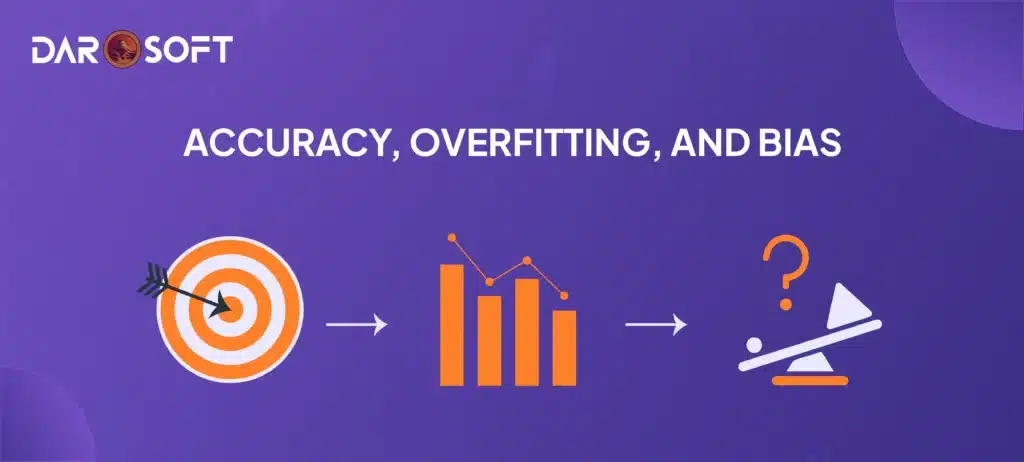
Accuracy, Overfitting, and Bias: Why ML Isn’t Always Right
Machine learning can do amazing things, predict diseases, drive cars, and recommend your next favourite show, but it’s not magic. Like any tool, it’s only as good as the data and decisions behind it.
Let’s explore why ML isn’t always right and what you can do about it.
Accuracy: It’s Not Just a Score
Accuracy tells us how often a model gets things right. Sounds simple, right?
But there’s a catch:
A model with 95% accuracy might still be terrible if it’s always predicting the majority case and ignoring edge cases.
Example:
Imagine a model that predicts if a customer will churn. If 95 out of 100 don’t churn, the model could just say “no” every time and still get 95% accuracy while missing all the important “yes” cases.
Moral: Accuracy alone doesn’t tell the whole story. You also need to look at precision, recall, and how costly mistakes are.
Overfitting: When the Model Memorises, Not Learns
Overfitting happens when a model becomes too “smart” for its own good; it memorises the training data, including noise and quirks, rather than learning general patterns.
It’s like a student who memorises past papers word-for-word but fails when the exam questions change.
Signs of overfitting:
High accuracy on training data
Low performance on new (real-world) data
Fix it with:
More diverse training data
Regularisation techniques
Simpler models or early stopping during training
Bias: The Unseen Danger in Your Data
Machine learning models learn from data. If that data reflects human bias, the model learns it too and may even amplify it.
Examples of bias:
Hiring models favouring certain demographics
Facial recognition performs poorly on underrepresented groups
Credit scoring disadvantages applicants from specific ZIP codes
Sources of bias:
Imbalanced datasets
Historical inequalities baked into data
Feature selection that reinforces stereotypes
Mitigate bias with:
Diverse and representative data
Fairness-aware algorithms
Regular audits of model decisions
Why It All Matters
When accuracy, overfitting, and bias aren’t managed:
Your predictions can mislead users
Your systems might behave unfairly
You lose trust, customers, and opportunities
TL;DR
Accuracy isn’t everything; context matters
Overfitting = memorising instead of learning
Bias in = bias out
Great models come from great data, thoughtful design, and ongoing evaluation
ML Tools & Frameworks + Learning Platforms
Name | Type | Best For | Highlights |
TensorFlow | Framework | Deep learning, scalable production apps | Google-backed, supports deployment on web, mobile, and edge devices |
PyTorch | Framework | Research, prototyping, computer vision, NLP | Dynamic computation graph, popular in academia and research |
Scikit-learn | Framework | Classical ML (SVM, regression, clustering, etc.) | Easy to learn, integrates well with NumPy & pandas |
Keras | Beginners in neural networks | High-level API for TensorFlow; minimal code for quick prototyping | |
XGBoost | Framework | Structured/tabular data, competitions (e.g., Kaggle) | Fast and accurate gradient boosting implementation |
LightGBM | Framework | Big data and high-speed training | Developed by Microsoft, great for performance-sensitive projects |
MLflow | Tool | Model lifecycle management | Open-source, track experiments, register models, reproduce runs |
Amazon SageMaker | Cloud ML Platform | Scalable ML in the AWS ecosystem | Build, train, and deploy ML at scale without managing infrastructure |
Google Vertex AI | Cloud ML Platform | Unified ML workflows in Google Cloud | Integrates with BigQuery, AutoML, and TensorFlow |
Azure Machine Learning | Cloud ML Platform | Enterprise ML with MLOps support | Advanced deployment tools, versioning, CI/CD pipelines |
Kaggle | Learning Platform | Competitions, data science projects | Hands-on projects, datasets, kernels, and real-world ML challenges |
Coursera | Learning Platform | Structured ML courses from universities | Learn ML from Stanford (Andrew Ng), Google, DeepLearning.AI |
edX | Learning Platform | Academic ML and AI courses | MIT, Harvard, and Microsoft certifications are available |
Udemy | Learning Platform | Affordable, practical ML tutorials | Learn TensorFlow, PyTorch, or deployment at your own pace |
Fast.ai | Framework + Course | Deep learning for coders | High-level PyTorch wrapper, free course emphasizes rapid development |
DataCamp | Learning Platform | Interactive ML coding lessons | In-browser coding in Python/R, great for data science beginners |
The Future of Machine Learning
Machine learning is becoming the invisible engine behind how the world works. From AI copilots that help write your emails to algorithms that predict diseases before symptoms appear, ML is quietly transforming everything from healthcare to customer service, logistics, and even entertainment.
But this isn’t just about technology, it’s about trust, personalisation, and solving problems at a scale we’ve never seen before. As we look ahead, understanding where ML is going helps us prepare for a world where machines won’t just follow instructions, they’ll learn, adapt, and collaborate with us.