- Written by: Hummaid Naseer
- October 29, 2025
- Categories: Services & Products
Cyberattacks are no longer a matter of if but when. From ransomware shutting down hospitals to phishing scams targeting everyday employees, the scale and frequency of attacks continue to rise. What’s even more concerning is that 90% of breaches involve human errorwhether it’s falling for a phishing email, using weak passwords, or misconfiguring critical systems.
This makes one thing clear: cybersecurity isn’t just about deploying firewalls, encryption, or advanced security tools. While technology plays a crucial role, the human element remains the weakest link and often the first target for attackers. True resilience against modern threats requires building a security-aware culture, where people, processes, and technology work together to protect organizations.
The Cost of Ignoring Cybersecurity Training
Cybersecurity training is often viewed as an optional expense, but in reality, it is one of the most cost-effective investments an organization can make. Ignoring it leaves businesses exposed not only to hackers but also to financial, reputational, and regulatory risks that can be far more expensive than preventive measures.
Financial Losses
The financial toll of cyberattacks can be devastating.
Ransomware: Attackers encrypt business-critical data and demand payment, sometimes in the millions, for its release. Even if a ransom is paid, there’s no guarantee the data will be restored.
Data Theft: Stolen intellectual property, trade secrets, or customer information can cause competitive disadvantages and loss of future revenue.
Downtime Costs: Every minute of system downtime means lost productivity, stalled operations, and frustrated customers. For industries like e-commerce or healthcare, downtime can quickly escalate into massive revenue losses or even life-threatening scenarios.
According to industry studies, the average cost of a data breach in 2023 exceeded $4.45 million, and this figure continues to climb each year.
Reputational Damage
Trust is the currency of the digital age.
Customer Trust Erosion: Once sensitive data is exposed, customers may no longer feel safe doing business with the company.
Brand Damage: A single headline about a breach can tarnish a brand’s image, overshadowing years of positive reputation-building.
Competitive Disadvantage: While one company struggles to regain trust, competitors can step in to capture market share.
Reputation loss doesn’t show up on balance sheets immediately, but its long-term effects can cripple customer retention and revenue growth.
Regulatory Fines and Compliance Risks
Governments and industry regulators are taking data protection more seriously than ever. Failing to train employees on cybersecurity best practices can lead to noncompliance with frameworks like:
GDPR (General Data Protection Regulation) → Noncompliance fines can reach up to 4% of annual global turnover.
HIPAA (Health Insurance Portability and Accountability Act) → Healthcare providers face penalties for mishandling patient data.
PCI-DSS (Payment Card Industry Data Security Standard) → Businesses handling payment data must comply or face fines and restrictions.
Regulatory fines are often just the beginninginvestigations, lawsuits, and mandated compliance upgrades add further costs.
The Small Business Reality
While large enterprises may weather the storm of a breach, small and mid-sized businesses face harsher realities.
60% of small businesses close within six months of a cyberattack, according to multiple studies.
Lacking dedicated cybersecurity teams, these businesses are often unprepared for both the attack itself and the costly recovery process.
Even if they survive financially, the reputational hit can make it impossible to win back customer confidence.
Why Cybersecurity Training Matters
Technology alone cannot protect organizations from cyber threats. Firewalls, intrusion detection systems, and antivirus tools are essential, but they can all be bypassed if an unsuspecting employee clicks a malicious link or mishandles sensitive data. That’s why cybersecurity training is critical to transform employees from potential vulnerabilities into empowered defenders.
Building a Human Firewall
Employees are the first line of defense against cyber threats. Attackers often target people instead of systems because humans are easier to trick. With proper training, staff can act as a “human firewall”, identifying and blocking threats before they escalate into full-blown breaches.
Phishing Awareness
Phishing remains the most common entry point for cyberattacks. A single click on a fraudulent email can give attackers access to an entire network. Training equips employees to:
Recognize suspicious subject lines, links, and attachments.
Verify sender authenticity before responding.
Report phishing attempts immediately to IT teams.
With regular simulations and practice, employees become skilled at spotting scams that even advanced filters might miss.
Password Hygiene and Multi-Factor Authentication (MFA)
Weak or reused passwords are a hacker’s dream. Cybersecurity training instills best practices such as:
Creating strong, unique passwords for every account.
Avoiding common mistakes like storing credentials in unsecured documents.
Enabling multi-factor authentication (MFA), which adds a critical second layer of protection even if a password is compromised.
Good password hygiene reduces the risk of credential theft, which is one of the leading causes of breaches today.
Safe Data Handling Practices
Data leaks often happen unintentionally when employees mishandle sensitive information. Training ensures staff know how to:
Classify and handle confidential data appropriately.
Use encrypted communication channels for sensitive exchanges.
Avoid unsafe behaviors like emailing files to personal accounts or using unauthorized storage tools.
By promoting responsible data handling, organizations can reduce both the risk of leaks and the likelihood of noncompliance with regulations like GDPR or HIPAA.
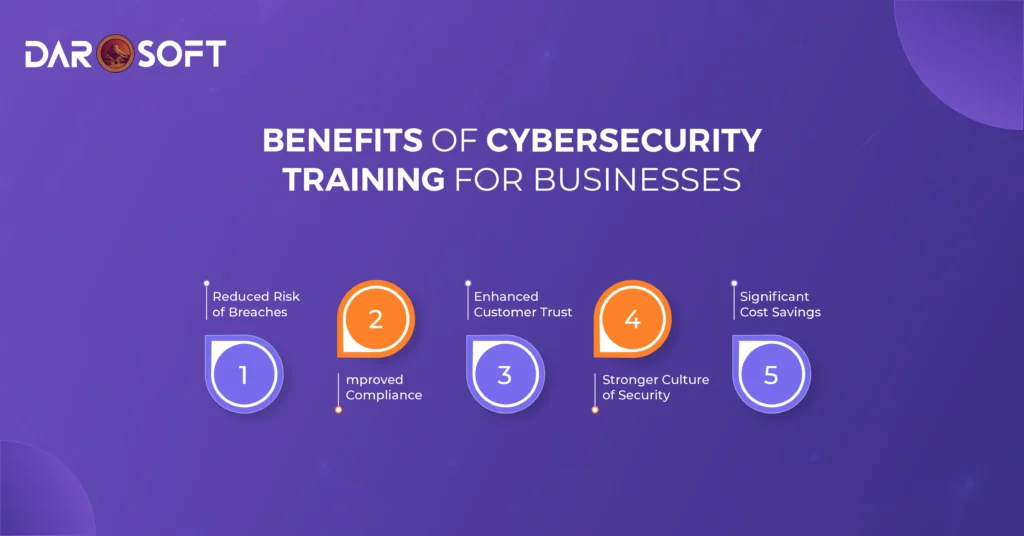
Benefits of Cybersecurity Training for Businesses
Investing in cybersecurity training delivers more than just educated employees strengthens the entire organization. By equipping staff with the knowledge and tools to recognize and prevent cyber threats, businesses gain measurable advantages that go far beyond compliance checkboxes.
Reduced Risk of Breaches
Well-trained employees are less likely to fall for phishing attacks, mishandle passwords, or misconfigure systems. This means fewer incidents caused by negligence, which translates directly into stronger organizational resilience and less downtime.
Improved Compliance
Regulations such as GDPR, HIPAA, and PCI-DSS require businesses to demonstrate data protection efforts, including employee training. By integrating security awareness programs, companies not only reduce legal risks but also streamline compliance audits and avoid costly fines.
Enhanced Customer Trust
Today’s customers are highly aware of cybersecurity risks. Businesses that can demonstrate robust security practicesincluding ongoing employee trainingearn greater trust. When clients feel confident that their data is protected, they are more likely to remain loyal and recommend the brand.
Stronger Culture of Security
Training fosters a culture where employees view cybersecurity as everyone’s responsibility, not just IT’s job. When staff are empowered to spot risks, report incidents, and take proactive action, the organization develops a security-first mindset that becomes part of daily operations.
Significant Cost Savings
Prevention is always cheaper than recovery. The cost of training programs is minimal compared to expenses tied to data breachesransomware payments, downtime, regulatory fines, and reputational repair campaigns. Investing in people upfront saves millions down the line.
Key Elements of an Effective Cybersecurity Training Program
Not all training programs are created equal. To be effective, cybersecurity training must be ongoing, practical, and tailored to real-world threats. A checklist approach won’t cut employees need interactive and evolving programs that keep security top of mind.
Regular Phishing Simulations
Phishing is the most common attack vector, so simulations are critical.
Conduct periodic mock phishing campaigns to test employee awareness.
Provide immediate feedback and guidance to those who fall for simulated scams.
Track improvements over time to measure training effectiveness.
These exercises transform theory into practice, helping employees build lasting instincts.
Workshops on Secure Email & Internet Usage
Simple mistakes like clicking unsafe links, downloading attachments, or visiting compromised websites often lead to breaches. Workshops should cover:
Safe browsing practices.
Identifying suspicious emails.
Avoiding the use of unauthorized applications or “shadow IT.”
Interactive sessions ensure staff understand both what to avoid and why it matters.
Incident Response Training
Employees should know what to do when something goes wrong. Training should include:
Recognizing early signs of compromise (e.g., unusual logins, slow systems).
Immediate steps to take (disconnecting from the network, reporting incidents).
Following the company’s incident response protocols without delay.
The faster employees respond, the smaller the damage.
Password Management & MFA Enforcement
Strong authentication practices are the foundation of security. Training should emphasize:
Creating and managing strong, unique passwords.
Use secure password managers instead of unsafe storage methods.
Enabling and properly using multi-factor authentication (MFA).
This drastically reduces the risk of compromised credentials leading to breaches.
Updated Sessions on Evolving Threats
Cyber threats evolve quickly, and so should training. Programs must regularly address:
AI-driven phishing attacks that mimic human writing styles.
Deepfakes are used for social engineering.
Emerging malware trends and ransomware tactics.
Industry-specific risks (e.g., healthcare data theft, financial fraud).
Keeping content fresh ensures employees stay alert to modern attack strategies, not just yesterday’s threats.
The Future of Cybersecurity Training
As cyber threats grow more complex, training methods must also evolve. The future of cybersecurity awareness isn’t about long, boring seminars’s about engaging, adaptive, and personalized learning experiences that make security second nature for employees.
Gamified Learning (Cyber Drills & Simulations)
Traditional slide decks and lectures don’t stick. Gamification makes training interactive and memorable by:
Using cybersecurity drills where employees “play” attackers vs. defenders.
Rewarding quick detection of phishing attempts or simulated breaches.
Creating healthy competition between teams to boost engagement.
Gamified exercises turn abstract risks into real-world challenges employees can relate to.
Micro-Learning for Busy Teams
Attention spans are short, and workloads are heavy. Instead of lengthy sessions, the future will see short, focused modules delivered in bursts:
5–10 minute lessons on specific topics (e.g., safe Wi-Fi use, spotting fake invoices).
Delivered through mobile apps, Slack, or email for convenience.
Repeated periodically to reinforce knowledge without overwhelming employees.
This approach ensures consistent awareness while respecting employees’ time.
AI-Based Adaptive Training
Artificial intelligence will make cybersecurity training smarter and more personalized by:
Tracking employee behavior (e.g., who clicks phishing simulations most often).
Adapting content to individual weaknesses (e.g., sending more phishing lessons to vulnerable employees).
Predicting risky behaviors and proactively delivering just-in-time learning.
With adaptive training, organizations can ensure that each employee gets the right level of support, maximizing impact while minimizing wasted effort.
Conclusion
Cybersecurity toolsfirewalls, monitoring systems, and antivirus software, are vital, but without trained people using them correctly, their effectiveness collapses. Technology can only go so far; it’s the human element that often determines whether an organization withstands or falls victim to an attack.
Businesses that treat cybersecurity training as an investment rather than a cost gain measurable advantages:
They save money by preventing costly breaches and downtime.
They protect their reputation by demonstrating care for customer and partner data.
They build resilience, ensuring the organization can adapt to new and evolving threats.