- Written by: Darosoft
- June 18, 2025
- Categories: Custom Software & App Development
Artificial Intelligence (AI) is rapidly transforming industries worldwide, driving innovation and efficiency across diverse sectors. From healthcare and finance to manufacturing and retail, AI is enabling smarter decision-making, automating complex tasks, and enhancing customer experiences.
In healthcare, it supports faster diagnoses and personalized treatments, while in finance, it powers fraud detection and predictive analytics. Retailers use AI for personalized shopping experiences, and manufacturers rely on it for predictive maintenance and process optimization. As AI technologies continue to evolve, their impact will only grow, reshaping the way businesses operate and deliver value.
The Evolution of Custom Software Development
Custom software development has evolved significantly from its traditional roots, which were often marked by rigid processes, long development cycles, and high costs. Traditional development faced challenges such as limited scalability, difficulty in adapting to changing business needs, and a heavy reliance on manual coding and testing.
As technology advanced, the industry began shifting toward automation and intelligence. Modern development practices now leverage AI, low-code/no-code platforms, and DevOps methodologies to accelerate delivery, enhance flexibility, and reduce human error. This shift is enabling businesses to create smarter, more adaptive software solutions tailored precisely to user needs, driving innovation and efficiency like never before.
The Role of AI in Modern Software Development
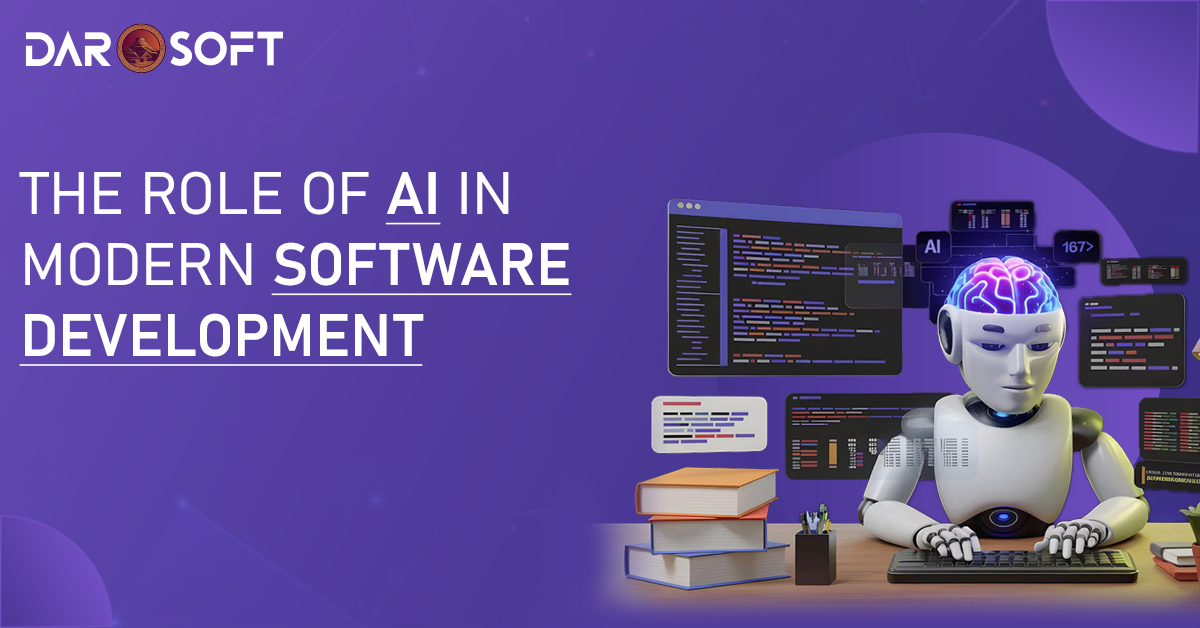
Artificial Intelligence is not just a tool—it’s a game-changer in how software is built and evolved. Traditional logic-based programming relies on fixed rules and manual coding, often limiting flexibility and scalability. In contrast, AI introduces adaptability and learning into the development process, enabling systems to make intelligent decisions and improve over time. From automating code generation and bug detection to enhancing testing and performance optimization, AI is streamlining every stage of the development lifecycle.It also powers smarter user experiences through personalization and predictive behavior. By integrating AI into our development toolkit, we deliver solutions that are not only faster to build but also more intuitive, resilient, and future-ready.
AI-Powered Features in Custom `Applications
The power of AI lies in its ability to integrate intelligent features into custom applications, enhancing functionality and user experience. Predictive analytics enables our solutions to anticipate user behavior, forecast trends, and support data-driven decision-making. Natural Language Processing (NLP) allows users to interact with apps using everyday language, making interfaces more intuitive and responsive.We also integrate advanced image and voice recognition for applications that require biometric authentication, visual search, or hands-free operation. Smart automation and AI-powered bots streamline workflows, reducing manual effort and increasing efficiency. Additionally, recommendation engines personalize content, products, or services for each user, driving engagement and satisfaction. These AI-driven capabilities position our applications to meet the demands of both modern users and businesses.

How AI Enhances the Software Development Lifecycle
- Requirements Gathering
- Uses AI-driven customer behavior analysis to identify trends and suggest relevant features.
- Gathers insights from large volumes of user feedback and interactions.
- Design & Prototyping
- Leverages AI-assisted UI/UX tools, such as heatmap analysis, to optimize design layouts.
- Predicts user interaction behavior to improve usability early in the process.
- Development
- Employs AI-based code generation and real-time coding assistance (e.g., GitHub Copilot).
- Enhances productivity and reduces manual coding errors.
- Testing & Quality Assurance
- Automates intelligent test case generation and execution.
- Improves bug detection accuracy and reduces QA cycle time.
- Maintenance
- Implements predictive issue detection to identify and address potential problems early.
- Enables self-healing systems that automatically resolve common issues.
Benefits of Integrating AI into Custom Software
- Faster Development Cycles: Accelerates coding, testing, and deployment through automation and intelligent tools.
- Reduced Human Error: Minimizes bugs and inconsistencies with AI-assisted code reviews and QA processes.
- Scalable, Adaptive Systems: Enables applications to learn, adapt, and grow with changing user and business needs.
- Improved User Experiences: Personalizes interfaces and interactions using AI-driven recommendations and behavior analysis.
- Cost-Efficiency Over Time: Lowers long-term operational costs by automating repetitive tasks and optimizing system performance.
Data quality and availability
Integrating AI into custom software brings immense value, but it also introduces several key challenges. One of the most critical is data quality and availability AI systems require large, accurate, and well-labeled datasets to deliver meaningful results. Without high-quality data, the performance of AI models can be significantly compromised. Another challenge is the training time and complexity involved in building effective AI models, which often demands substantial computational resources and specialized expertise.
Beyond technical hurdles, there are important ethical and legal considerations. Issues such as data privacy, algorithmic bias, and regulatory compliance (e.g., GDPR) must be carefully managed to ensure responsible AI deployment. Additionally, the cost of AI integration—from development and infrastructure to ongoing maintenance can be substantial, particularly for startups or smaller organizations. At Darosoft, we address these challenges with a strategic, transparent approach, ensuring AI solutions are both effective and aligned with our clients’ operational and ethical standards.
AI in the Real World
Logistics – DHL
- Route & warehouse optimization: DHL uses AI for pallet scanning, route planning, and warehouse robotics to speed operations and reduce errors [Wired.com]
- Predictive analytics & load efficiency: Its AI platform analyzes shipping data, weather, and traffic to improve delivery reliability; tools like OptiCarton optimize packaging and load space, cutting costs and emissionsDHL Freight
- Digital twins: Simulating warehouse environments virtually helps DHL test layout and staffing scenarios, boosting picking speed by ~30% and energy efficiency by ~25%freightamigo.com
Healthcare – IBM Watson & Partners
- Cancer care: IBM Watson for Oncology supports tumor boards with evidence-based treatment suggestions; at Manipal and other hospitals, Watson changed 13.6% of treatment decisions, [thanks to its updated insights]
- Clinical trial matching: Health Quest’s use of Watson Clinical Trial Matching boosted trial enrollment by ~84% and slashed screening time from nearly 2 hours to just 24 minutes hhmglobal.com
- Remote and rural diagnostics: Manipal Hospital in India employs IBM’s cognitive computing to provide personalized cancer treatment and telemedicine to patients in remote areas.
Retail – Amazon
- Amazon leverages AI-driven recommendation engines and dynamic pricing systems that significantly enhance sales through personalized user experiences (widely documented across industry analyses).
What the Future Holds
Meanwhile, hyper-personalization at scale will redefine user experiences, delivering content, products, and services tailored to individual needs in real time. This shift marks a new era of smarter, faster, and more accessible digital innovation. Thus, the future of software development lies at the intersection of AI and emerging technologies. AI combined with low-code/no-code platforms will empower non-developers to build intelligent applications quickly and efficiently.