- Written by: Hummaid Naseer
- July 18, 2025
- Categories: business strategy
Digital maturity goes far beyond swapping paper for screens; it shows how effectively your organisation uses technology to drive strategy, innovation, and performance. It reflects your ability to embed digital tools into daily operations, harness data for smarter decisions, and adapt quickly to change.
Instead of treating tech adoption as a one-off project, digitally mature teams align technology with core business goals. They break silos, automate processes, and deliver personalised, data-driven experiences across every function.
By embracing digital maturity as a strategic advantage, you create a culture that constantly learns, iterates, and innovates. In today’s fast-moving market, companies that lead with digital thinking don’t just keep up, they set the pace.
What Is Digital Maturity?
Digital maturity is not about having the latest tech; it’s about how effectively your organisation uses digital tools to solve real problems, serve customers better, and make smarter decisions.
Think of it as a journey, not a finish line. A digitally mature business doesn’t just “go digital” once; it continually evolves. It starts by digitising basic operations (like moving from paper to cloud), but over time, it connects systems, automates workflows, and leverages data to drive strategy and innovation.
In simple terms, digital maturity reflects your company’s ability to adapt, compete, and thrive in a fast-changing, tech-driven world. The more mature you are, the more agile, efficient, and customer-focused your business becomes.
The Digital Maturity Spectrum
Digital maturity isn’t binary. It evolves across a spectrum. Each stage represents how deeply digital tools and mindsets are embedded in your organisation. Here’s a breakdown of the five key stages:
Traditional
What it looks like:
Heavy reliance on paper, spreadsheets, and manual processes.
Minimal use of digital tools; tech is often seen as a cost rather than a value driver.
Typical mindset:
“If it’s not broken, why fix it?”
Common traits:
Silo departments
Limited data collection or analysis
Decisions driven by intuition rather than data
Digitally Aware
What it looks like:
Teams have started using digital tools in isolated areas (e.g., C.R.M, cloud storage).
Some automation exists, but it’s not standardised.
Typical mindset:
“We know tech can help, we just haven’t rolled it out consistently.”
Common traits:
Pilot projects or early adoption
Growing awareness of data and efficiency
Some resistance to change
Digitally Enabled
What it looks like:
Core operations are digitised and connected.
Cloud tools, collaboration platforms, and basic analytics are in active use.
Typical mindset:
“Digital is part of how we work—but not yet who we are.”
Common traits:
Improved productivity and communication
Cross-functional use of digital tools
Some data-driven decision-making
Fully Digital
What it looks like:
Digital technology is deeply integrated across all departments.
Data flows seamlessly and supports day-to-day operations and strategy.
Typical mindset:
“Digital is how we operate and compete.”
Common traits:
Real-time data used across teams
Strong tech-savvy culture
Digitally Transformation
What it looks like:
The company leads with digital innovation, transforming markets, products, and customer experiences.
AI, machine learning, and predictive analytics drive continuous improvement.
Typical mindset:
“We use technology to reinvent what’s possible.”
Common traits:
Culture of experimentation and innovation
Continuous adaptation to market trends
Data is strategic, not just operational
Tech is a competitive advantage
Core Pillars That Define Digital Maturity
Digital maturity isn’t just about having the latest tech.It’s about how strategically and cohesively an organisation uses digital capabilities across every layer of its operations. These six pillars form the foundation of a digitally mature business:
1. Technology Infrastructure
A strong, flexible IT backbone is essential. This includes modern cloud platforms, scalable architectures, and secure systems that support innovation and resilience.
Key traits:
Cloud-native or hybrid environments
Scalable storage and computing power
Integrated systems (CRM, ERP, etc.)
Security and compliance by design
2. Data and Analytics
Mature organisations treat data as a strategic asset. It fuels everything from operations to decision-making, and it’s governed for quality, availability, and insight generation.
Key traits:
Unified data platforms or lakes
Real-time dashboards and KPIs
Predictive analytics and AI usage
Data governance and lineage tracking
3. Culture and Skills
Digital transformation thrives in cultures that value learning, experimentation, and cross-functional collaboration. Teams must be digitally literate and open to continuous change.
Key traits:
Digital fluency across teams
Up-skilling and re-skilling initiatives
Agile, empowered teams
Openness to experimentation and failure
4. Processes and Automation
Digitally mature companies redesign workflows for efficiency and adaptability. They automate routine tasks and optimise end-to-end processes using technology.
Key traits:
Automated workflows (e.g., via RPA, BPM tools)
Integrated DevOps and CI/CD pipelines
Lean, data-informed process improvement
Scalability without sacrificing speed
5. Customer Experience
Customer-centric drives digital maturity. This includes personalised experiences, omni-channel access, and proactive engagement based on behavioural data.
Key traits:
Personalised product recommendations
Seamless digital journeys (web, mobile, voice)
Customer feedback loops
Experience design backed by behavioural analytics
6. Leadership and Vision
Strategic leadership is the anchor of digital maturity. Leaders must align digital goals with business outcomes and foster a culture of innovation and accountability.
Key traits:
Clear digital strategy aligned with business goals
Visionary leadership driving transformation
Transparent decision-making
Change management and stakeholder alignment
Why Digital Maturity Matters More Than Ever
Organisations that actively invest in digital capabilities across their infrastructure, processes, and culture are outperforming their peers in measurable ways. Here’s how:
Faster Decision-Making
Digitally mature businesses have centralised, real-time data access that eliminates guesswork. Executives, managers, and front-line teams alike can make informed decisions quickly. Whether it’s adjusting a supply chain in response to market shifts or launching a new campaign based on live customer feedback.
Result: Shorter planning cycles, quicker pivots, and faster time-to-market.
Higher Operational Efficiency
Automation and optimised workflows reduce friction and overhead. From robotic process automation (RPA) in finance to self-service IT support, digital maturity frees up human effort for higher-value work.
Result: Lower operating costs, improved accuracy, and faster execution across departments.
Stronger Customer Relationships
Digitally advanced companies deliver personalised, seamless experiences across every touch-point. They understand customer needs in real-time and respond proactively—whether through intelligent chat-bots, tailored content, or predictive support.
Result: Increased customer satisfaction, retention, and lifetime value.
Greater Agility and Innovation
Digital maturity supports experimentation. With agile practices, cloud-based environments, and AI-enhanced insights, businesses can test, learn, and scale ideas faster—without the risk of technical debt holding them back.
Result: Faster innovation cycles, improved product-market fit, and resilient business models.
Long-Term Competitiveness
Companies with high digital maturity don’t just react to change—they shape it. They attract top talent, partner more effectively, and adapt to new technologies and market conditions with confidence.
Result: Sustainable growth, future-proof strategy, and industry leadership.
Use Cases Across Industries
Retail: Personalised e-Commerce
Use Case: A digitally mature retail brand leverages customer data, machine learning, and CRM integration to offer dynamic pricing, personalised product recommendations, and real-time support.
Result: Higher conversion rates, improved customer retention, and increased average order value.
Manufacturing: Smart Operations
Use Case: A manufacturer implements IoT sensors and AI-driven analytics across its production line to monitor equipment health, predict maintenance needs, and optimise energy usage.
Result: Reduced downtime, lower operational costs, and better supply chain visibility.
Healthcare: Digital Patient Engagement
Use Case: A hospital network introduces a mobile app and digital portal that allows patients to schedule appointments, access records, and chat with providers.
Result: Improved patient satisfaction, reduced no-shows, and more efficient care delivery.
Finance: Automated Risk Analysis
Use Case: A fintech startup uses real-time data pipelines and predictive analytics to assess credit risk instantly and flag potential fraud before it happens.
Result: Faster approvals, fewer defaults, and stronger compliance with regulatory standards.
How to Assess Your Organisation’s Digital Maturity
To understand where your organisation stands on the digital maturity spectrum and where it needs to go, assessment is key. This process helps pinpoint strengths, uncover gaps, and prioritise initiatives that align with your business strategy. Here’s how to get started:
Use a Digital Maturity Model
Several industry-recognised frameworks can help you benchmark your progress. Popular models include:
Deloitte’s Digital Maturity Model (focuses on customer, strategy, technology, operations, and culture)
BCG’s Digital Acceleration Index
MIT-Capgemini Digital Transformation Framework
Conduct a Self-Assessment
Use structured surveys or workshops to evaluate maturity across key domains. Sample questions include:
Technology & Infrastructure
Are your core systems cloud-based and scalable?
How quickly can IT respond to new business needs?
Data & Analytics
Do teams have access to real-time data dashboards?
Is data being used to inform decisions across all departments?
Culture & Skills
Are digital skills actively developed and rewarded?
Is innovation encouraged, or is risk-taking punished?
Processes & Automation
Are key workflows automated and standardised?
Can teams rapidly test, learn, and iterate?
Customer Experience
Is the customer journey mapped and digitally optimised?
Do you use personalisation or AI to improve service?
Leadership & Vision
Does leadership have a clear digital roadmap?
Is digital transformation treated as a strategic priority or a tech initiative?
Cross-Team Conversations
Digital maturity is not the job of IT alone. Engage multiple departments: finance, operations, HR, product, and customer service to get a holistic view. Different functions may be at different stages of maturity.
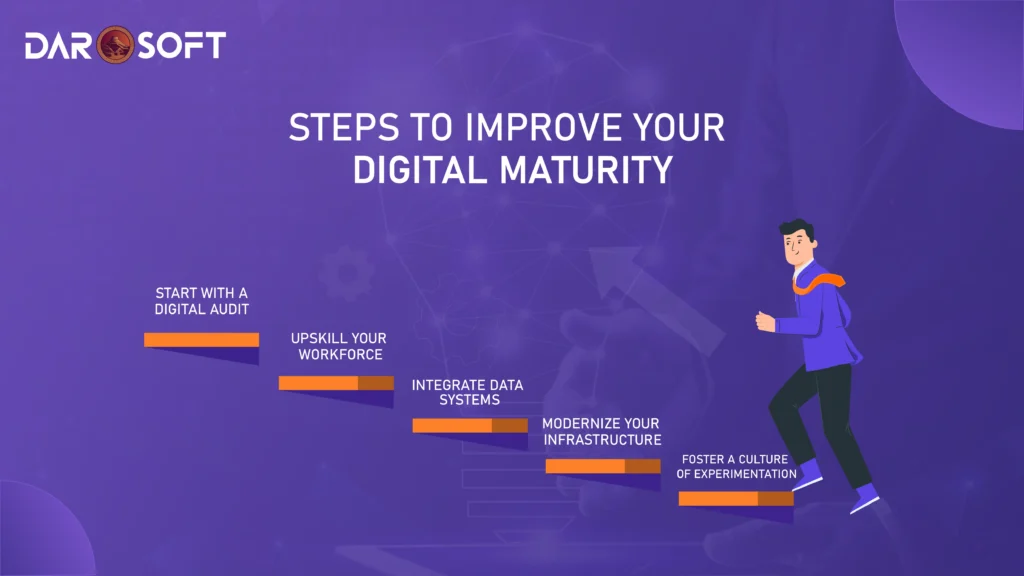
Steps to Improve Your Digital Maturity
Start with a Digital Audit
Evaluate your current capabilities across technology, data, operations, and culture. Use a maturity framework (e.g., Deloitte, BCG, or MIT-Capgemini) to benchmark your standing.
Identify what’s working, what’s outdated, and where digital silos exist.
Pinpoint gaps that are blocking agility, efficiency, or customer experience.
Outcome: A clear baseline to guide your transformation priorities.
Upskill Your Workforce
Technology alone won’t transform your business.
Invest in continuous learning to help employees thrive in a digital-first environment.
Launch training on digital tools, analytics, cybersecurity, and agile methods.
Encourage cross-functional collaboration and knowledge sharing.
Outcome: A digitally fluent workforce ready to adopt and adapt.
Integrate Data Systems
Disconnected data is one of the biggest blockers to insight and innovation.
Unify your data landscape to ensure timely, accurate, and accessible information across the organisation.
Break down data silos between departments (e.g., CRM, ERP, POS).
Adopt a single source of truth using data warehouses or lakes (e.g., Snowflake, BigQuery).
Outcome: Faster, data-driven decision-making at all levels.
Modernise Your Infrastructure
Legacy systems often can’t keep up with the demands of real-time business.
Migrate to scalable, cloud-native architectures that support speed, security, and flexibility.
Move core systems to the cloud (IaaS, PaaS, SaaS).
Embrace APIs and micro-services for interoperability and faster innovation.
Outcome: A tech foundation built for agility and scale.
Foster a Culture of Experimentation
Digital maturity thrives in environments where innovation is rewarded, not punished.
Promote a test-and-learn mindset across all teams.
Empower teams to run small experiments with clear KPIs.
Celebrate learnings from both successes and failures.
Outcome: An adaptive organisation that continuously improves.
Conclusion
Digital maturity is not about chasing the latest tools or trends; it’s about building a long-term, strategic foundation that empowers your business to adapt, compete, and grow. It touches every part of the organisation, from how decisions are made to how customers are served and how innovation is delivered.