- Written by: Hummaid Naseer
- October 6, 2025
- Categories: Services & Products
Customer Lifetime Value (CLV) is one of the most critical metrics for sustainable business growth. Unlike one-off sales figures, CLV examines the entire relationship with a customer, measuring the revenue they generate throughout their journey with your brand, from their initial purchase to repeat orders, cross-sells, and long-term loyalty.
Why does this matter? Because not all customers are equal. Some bring value through frequent, high-margin purchases, while others might buy once and never return. By understanding CLV, businesses can:
Prioritise high-value customers with targeted marketing and personalised experiences.
Allocate ad spend more efficiently, focusing on customer segments that deliver long-term returns.
Build loyalty strategies (such as subscriptions, bundles, or rewards programs) that increase retention and repeat purchases.
Forecast revenue with greater accuracy, since CLV highlights how much each customer is truly worth over time.
Sales reports play a foundational role in calculating CLV. They provide the raw data, purchase history, frequency, margins, and channel performance, which, when analysed, reveal which customers are most profitable and how to grow their value further.
What Is Customer Lifetime Value (CLV)?
Customer Lifetime Value (CLV) is the total revenue a business can expect from a single customer over the entire duration of their relationship with the brand. Unlike single-purchase sales metrics, CLV accounts for repeat purchases, upsells, cross-sells, and retention rates, making it one of the most important profitability indicators.
Why it matters
Profitability focus – Retaining existing customers is 5–7x cheaper than acquiring new ones, and CLV helps identify where retention strategies pay off.
Resource allocation – Guides smarter spending on marketing, loyalty programs, and customer service.
Growth strategy – Businesses with higher CLV per customer can outspend competitors on acquisition while still staying profitable.
The CLV Formula
CLV = Average Purchase Value × Purchase Frequency × Customer Lifespan
Average Purchase Value = Total revenue ÷ Number of purchases
Purchase Frequency = Number of purchases ÷ Number of customers
Customer Lifespan = Average duration (in months or years) a customer stays active
Example
Average purchase value = $50
Purchase frequency = 4 per year
Customer lifespan = 5 years
CLV = 50×4×5 = $ 1,000
So, on average, each customer contributes $1,000 in lifetime revenue.
Advanced CLV Formula (Profit-Based)
To make it more accurate, businesses often calculate CLV in terms of profitability instead of just revenue:
CLV = (Average Order Value×Gross Margin×Purchase Frequency) / Churn Rate
Where:
Gross Margin = Profitability after costs
Churn Rate = Percentage of customers lost over a period
This version adjusts for margins and customer attrition, giving a true financial impact rather than just top-line sales.
Using Sales Reports to Track CLV Components
Sales reports are the backbone of Customer Lifetime Value (CLV) analysis. They provide the raw numbers that allow businesses to move beyond guesswork and calculate CLV with accuracy. By breaking down the components of CLV, sales reports reveal not just how much customers spend, but also how often and for how long.
Average Order Value (AOV)
Definition: The average amount a customer spends per transaction.
Formula:
AOV = Total Revenue / Number of Orders
How Sales Reports Help:
Show spend patterns per customer segment (e.g., wholesale buyers may have a higher AOV than retail customers).
Identify opportunities to increase basket size through cross-sells, bundles, or upselling.
Spot products that consistently raise AOV when paired together.
Example:
Total revenue = $100,000
Total orders = 2,000
AOV = $50 per order
Purchase Frequency
Definition: How often a customer buys within a set time frame (month, quarter, year).
Formula:
Purchase Frequency = Total Orders / Number of Customers
How Sales Reports Help:
Reveal which customers buy once and never return vs. those making repeat purchases.
Highlight channels that encourage higher frequency (e.g., subscription models, loyalty programs).
Identify “gateway products” that lead to repeat business.
Example:
Total orders = 4,000
Unique customers = 1,000
Purchase Frequency = 4 orders per customer per year
Customer Lifespan
Definition: The average time (in months or years) a customer continues buying before churning.
Formula:
Customer Lifespan = Sum of Customer Lifetimes / Number of Customers
How Sales Reports Help:
Track when customers typically churn (e.g., after 6 months, 1 year, or 3 years).
Reveal segments with longer loyalty cycles, guiding retention campaigns.
Spot early warning signs, such as declining purchase frequency, to intervene with reactivation offers.
Example:
If the average customer remains active for 4 years, that’s your customer lifespan.
By combining AOV + Purchase Frequency + Customer Lifespan, sales reports give a clear and actionable CLV. This insight lets businesses spend wisely on acquisition, strengthen retention strategies, and maximize long-term profitability.
Segmenting Customers by CLV
Not all customers contribute equally to business growth. Some drive recurring revenue and long-term loyalty, while others purchase once and disappear. By segmenting customers based on Customer Lifetime Value (CLV), businesses can prioritize their efforts, personalize engagement, and allocate resources where they matter most.
High-Value Customers (VIPs)
Who they are: Customers with high CLV, frequent purchases, and strong brand loyalty.
How to identify them:
High Average Order Value (AOV).
Consistent purchase frequency over a long period.
Positive engagement (reviews, referrals, loyalty program participation).
Why they matter:
They drive a disproportionate share of revenue (Pareto’s 80/20 rule).
More likely to try new products and act as brand advocates.
Actionable Strategies:
Offer exclusive perks (early access, premium support, VIP discounts).
Launch referral programs to encourage word-of-mouth marketing.
Personalize upselling and cross-selling opportunities.
Medium-Value Customers (Growth Potential)
Who they are: Customers with moderate CLV who purchase occasionally but could be nurtured into higher-value buyers.
How to identify them:
Stable AOV but low purchase frequency.
Irregular buying patterns (e.g., only during sales or peak seasons).
Why they matter:
They represent untapped revenue potential.
Often just one incentive away from becoming repeat buyers.
Actionable Strategies:
Use targeted email campaigns to re-engage.
Introduce loyalty rewards to boost frequency.
Suggest personalized product recommendations.
Low-Value Customers (One-Time Buyers)
Who they are: Customers who make a single purchase and don’t return.
How to identify them:
Low CLV with one-off transactions.
No repeat activity in sales reports within the customer lifespan window.
Why they matter:
Still generate revenue, but acquiring too many of them raises CAC (Customer Acquisition Cost).
Some can be reactivated with proper retention strategies.
Actionable Strategies:
Offer post-purchase follow-ups with discounts or bundled deals.
Provide educational content to showcase product value.
Segment them into a reactivation campaign before writing them off.
Churn Risks
Who they are: Customers who once purchased actively but show signs of disengagement or inactivity.
How to identify them:
Declining purchase frequency in sales reports.
Long gaps since the last transaction.
Reduced response to promotions.
Why they matter:
Retaining an existing customer is 5x cheaper than acquiring a new one.
Winning them back boosts CLV and prevents revenue leakage.
Actionable Strategies:
Trigger win-back campaigns with personalised offers.
Collect feedback to uncover why they disengaged.
Introduce subscriptions or membership models to lock in loyalty.
By segmenting customers by CLV, businesses can double down on high-value VIPs, nurture medium-value customers, re-engage at-risk, and learn from low-value buyers. This creates a more efficient sales and marketing strategy, driven by hard data instead of assumptions.
Linking CLV to Marketing ROI
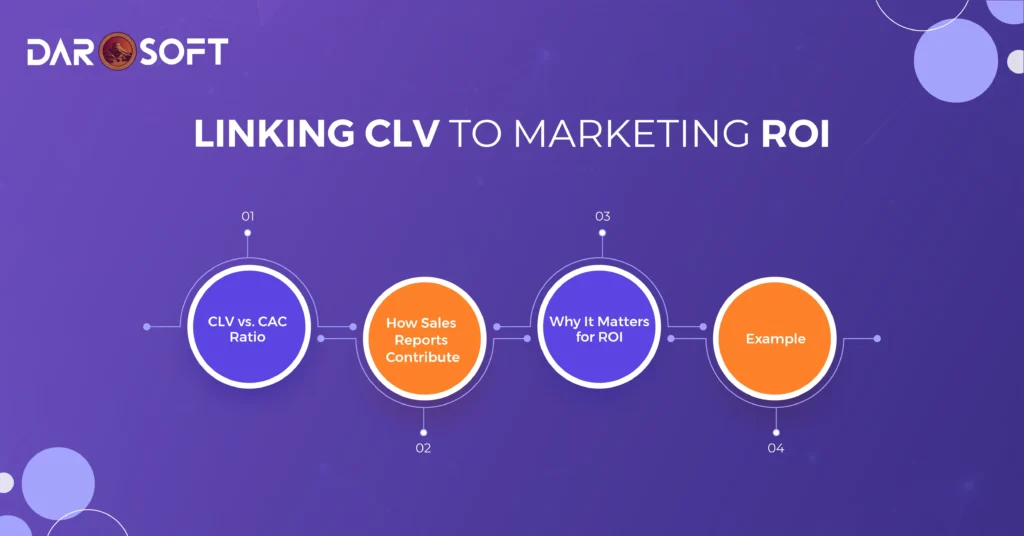
One of the most powerful ways to use Customer Lifetime Value (CLV) is by comparing it with Customer Acquisition Cost (CAC). Sales reports don’t just show how much revenue customers bring in — they help you calculate whether the money you spend on acquiring and retaining customers is truly paying off.
CLV vs. CAC Ratio
CLV-to-CAC Ratio = Customer Lifetime Value / Customer Acquisition Cost
Interpretation
A 3:1 ratio is considered healthy (for every $1 spent on acquisition, you earn $3 back in lifetime revenue).
Lower than 1:1: You’re spending more to acquire customers than they’re worth.
Higher than 5:1: You may be under-investing in growth opportunities.
How Sales Reports Contribute
Sales reports provide the key data points to evaluate this balance:
Average Order Value (AOV): Shows typical revenue per purchase.
Purchase Frequency: Indicates how often customers come back.
Customer Lifespan: Helps estimate how long customers stay active.
Combined, these metrics reveal CLV, which can be compared directly to CAC
Why It Matters for ROI
Justifying Marketing Spend: If CLV is significantly higher than CAC, it validates that marketing campaigns are generating profitable long-term customers.
Identifying Waste: If acquisition costs outweigh lifetime value, sales reports highlight which campaigns or channels are underperforming.
Guiding Budget Allocation: Sales reports by region, channel, or campaign help you double down on high-ROI acquisition sources.
Example
Scenario A: A customer acquired via Facebook ads costs $50 CAC, but their CLV is $300. Ratio = 6:1 → Profitable and scalable.
Scenario B: A customer from paid search costs $120 CAC, with a CLV of $100. Ratio = 0.8:1 → Unsustainable, needs fixing.
Identifying Revenue-Driving Products & Behaviors
Not all products contribute equally to long-term growth. Some items are simply one-time purchases, while others act as “gateway products” that bring customers back again and again. Sales reports can uncover these hidden drivers of loyalty and profitability.
Repeat-Purchase Products
What to look for: Products with the highest rate of repeat orders.
Why it matters: These items build customer habits and create consistent revenue streams. For example, consumables (like cosmetics, food items, or printer cartridges) often anchor repeat purchases.
How to use: Flag these products for priority in stock availability, marketing, and loyalty programs.
Bundles & Add-Ons
What to look for: Products frequently bought together or as upsells (e.g., a phone with a case, or gym equipment with supplements).
Why it matters: These bundles increase Average Order Value (AOV) and improve customer stickiness by offering more value in a single transaction.
How to use: Create bundle discounts, suggest add-ons at checkout, or run personalized promotions highlighting these combinations.
Gateway Products
What to look for: Low-cost or trending items that attract new customers.
Why it matters: Even if these products aren’t highly profitable individually, they introduce customers to your brand and lead to higher-value future purchases.
How to use: Feature gateway products in ads or promotions, but track whether these buyers convert into long-term customers through CLV analysis.
Cross-Sell & Up-Sell Indicators
What to look for: Products that naturally lead customers to buy higher-value items later.
Why it matters: These items show customer journey patterns, helping you design better funnels.
How to use: Place them in email drip campaigns, remarketing ads, or loyalty rewards.
Customer Behavior Insights
What to look for: Behavior trends in sales reports, such as:
Customers who start with small purchases but later buy premium products.
Specific categories that act as entry points to broader brand adoption.
Why it matters: Helps predict which new buyers are most likely to become high CLV customers.
Pro Tip: Combine product-level sales reports with customer behavior data (purchase frequency, average basket size, churn risk) to see not just which products sell, but which ones drive lasting relationships and revenue growth.
Improving CLV with Sales Insights
Customer Lifetime Value (CLV) doesn’t grow on its own — it’s built through deliberate strategies that encourage customers to buy more, buy often, and stay loyal. Sales reports are the foundation for spotting opportunities and tailoring retention efforts that directly improve CLV.
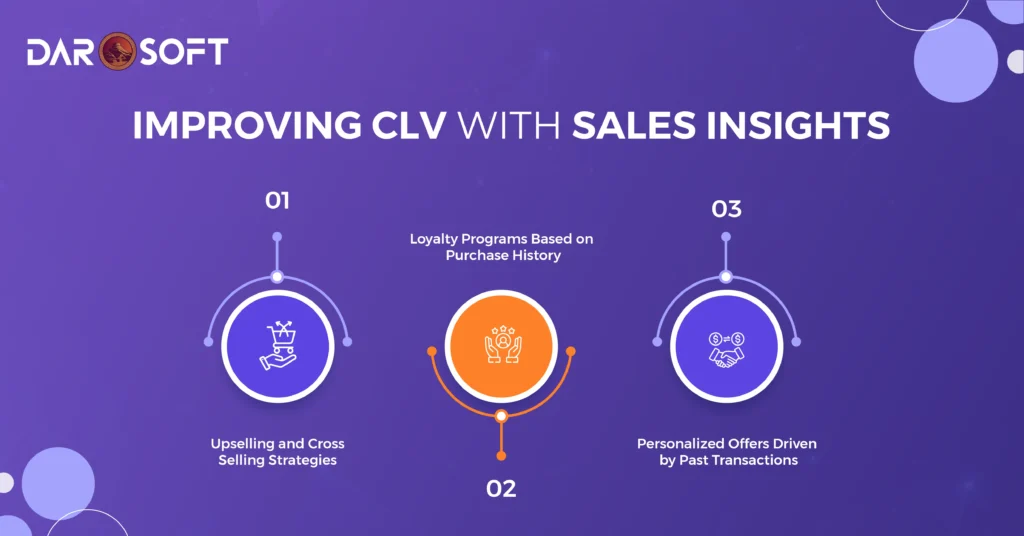
Upselling and Cross-Selling Strategies
How it works: Use sales data to identify which products customers are most likely to upgrade (upsell) or complement with add-ons (cross-sell).
Example: If many customers buy a mid-tier subscription, offer them an upgrade to a premium plan with added features. Similarly, pair a laptop sale with offers on accessories like a mouse or external storage.
CLV Impact: Increases Average Order Value (AOV) and ensures customers get deeper into your product ecosystem, making them harder to switch to competitors.
Loyalty Programs Based on Purchase History
How it works: Instead of generic discounts, tailor loyalty rewards to match customer buying patterns.
Example: If a customer frequently buys skincare products, offer them points or exclusive early access to new launches in that category.
CLV Impact: Strengthens customer retention, boosts repeat purchase rates, and creates emotional connections with the brand.
Personalized Offers Driven by Past Transactions
How it works: Analyze transaction history to send targeted offers.
Example:
A customer who bought a smartphone six months ago could receive an offer for compatible earbuds.
A buyer who regularly orders fitness gear might get personalized bundle discounts on supplements.
CLV Impact: Personalization increases conversion rates and drives higher engagement, ensuring marketing spend directly fuels long-term revenue.
Pro Tip: The key to improving CLV is data-driven personalization. Sales reports give you the raw insights, but success comes from turning those insights into timely, relevant offers that feel designed for each customer.
Forecasting CLV with Predictive Analytics
Sales reports give you a clear picture of past performance, but combining them with predictive analytics takes CLV management to the next level. Instead of simply reacting to customer behavior, businesses can forecast future revenue potential, spot churn risks early, and design strategies to maximize long-term value.
Using Historical Sales Reports + AI to Project Future Value
How it works: Feed historical transaction data (AOV, purchase frequency, retention rates) into predictive models.
Outcome: AI algorithms can segment customers into high-potential, moderate, and low-value groups based on projected lifetime revenue.
Example: A customer who bought 5 times in the last year with increasing order values may be flagged as a high CLV candidate, signaling the need for premium loyalty offers.
Spotting Churn Early
How it works: Predictive models analyze patterns like declining purchase frequency, smaller order sizes, or reduced engagement.
Outcome: Businesses can intervene before customers churn with targeted re-engagement offers, discounts, or reminders.
Example: If a subscription customer delays renewal by a week (a common churn signal), the system can trigger a personalized retention campaign automatically.
Reducing Attrition with Proactive Strategies
Approach:
Offer win-back discounts for customers showing inactivity.
Provide cross-channel engagement (email, SMS, app notifications) based on predicted buying windows.
Optimize customer service response times, since support dissatisfaction is often a churn trigger.
Impact: Extends customer lifespan, directly boosting CLV.
How Logisticify by Darosoft Helps
Managing Customer Lifetime Value (CLV) requires more than just crunching numbers. It demands real-time visibility, smart segmentation, and predictive insights. That’s where Logisticify by Darosoft comes in.
Centralized CLV Tracking: Logisticify automatically consolidates sales transactions, customer profiles, and purchase histories to calculate CLV at both the individual and segment level.
High-Value Customer Identification: The platform flags your most profitable customers — not just by revenue, but by their long-term contribution — helping you prioritize loyalty programs, VIP offers, and retention strategies.
Product-to-CLV Linkage: By tying product performance directly to customer longevity, Logisticify reveals which SKUs or bundles drive repeat purchases and which ones fail to create lasting relationships.
Predictive CLV Insights: With built-in analytics, the system projects future value by spotting churn risks early and recommending proactive engagement campaigns.
The result: Businesses move from short-term sales tracking to long-term growth strategies, ensuring that every marketing dollar spent and every inventory decision made contributes to maximizing lifetime value, not just immediate revenue.