- Written by: Hummaid Naseer
- November 6, 2025
- Categories: Tech Stack
Few terms in product development are as widely used and as frequently misunderstood as the Minimum Viable Product (MVP). It’s become a buzzword in the startup and software world, often invoked as a synonym for launching fast or cutting corners. Yet, beneath the hype, the true concept of the MVP is far more strategic and far more powerful.
The Popularity and Confusion: Around the Term “MVP”
In theory, everyone loves the idea of an MVP: build something small, test it quickly, and learn fast. In practice, though, teams interpret it in wildly different ways. To some, it’s a half-built version of the final product. To others, it’s a cheap prototype to show investors. And in many cases, it becomes a polished beta release disguised as “lean innovation.”
This confusion dilutes the concept’s real purpose and leads teams to miss the most valuable outcome of all, validated learning.
How Misconceptions Lead to Wasted Effort and Missed Validation
When the MVP is misunderstood, teams risk falling into common traps:
Overbuilding features before knowing if the product solves a real problem
Spending months refining a user interface no one has validated
Collecting feedback that measures preference, not proof of value
Instead of saving time and resources, these efforts push teams further away from what the MVP was meant to achieve: clarity through experimentation.
The Real Purpose of MVP Development in Modern Product Strategy
At its core, the MVP isn’t about minimal effort. It’s about maximum learning per unit of effort. It’s a disciplined approach to de-risk innovation, where each build cycle exists to test a specific assumption:
Is the problem worth solving?
Is our solution effective?
Do people care enough to engage or pay?
By reframing MVPs as learning experiments, teams can focus on evidence, not ego — using real data to guide product evolution.
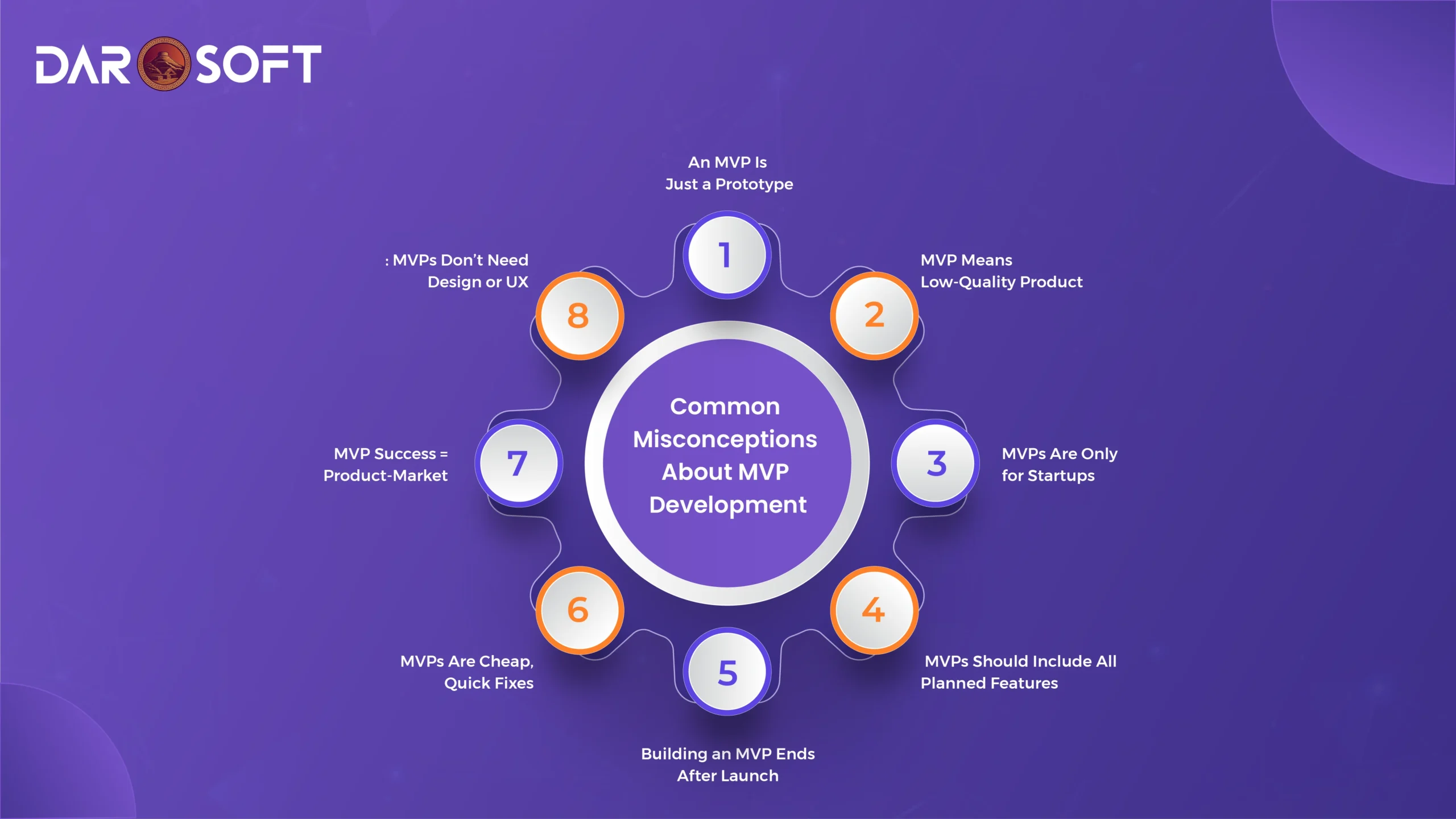
Misconception #1: An MVP Is Just a Prototype
One of the most common misunderstandings in product development is assuming that a Minimum Viable Product (MVP) is just another form of prototype. While both are essential tools for innovation, they serve very different purposes, and confusing them can derail your validation efforts before they even begin.
MVPs Test Real User Behavior
A prototype is a visual or interactive model of your idea, something that helps you explore user flows, test aesthetics, and gather early design feedback. It answers questions like:
Is the interface intuitive?
Do users understand how this works?
Does this concept make sense visually?
An MVP, on the other hand, is a working version of your product that tests real behavior in real conditions. It’s designed to validate critical assumptions such as:
Will users actually use or pay for this?
Does the core functionality solve a real problem?
Is there real market demand for what we’re building?
In short, prototypes help you imagine the product; MVPs help you prove it deserves to exist.
Difference in Goals, Audience, and Deliverables
Aspect | Prototype | MVP |
Goal | Explore design & usability | Validate product-market fit |
Audience | Internal stakeholders, test users | Real early adopters |
Deliverable | Clickable mockup or concept demo | Functional product with core features |
Validation Type | Qualitative (feedback-based) | Quantitative (behavior-based) |
Understanding this distinction ensures teams collect the right kind of feedback at the right time. A prototype tells you whether users like your idea — an MVP tells you whether they’ll commit to it.
A Clickable Figma Mockup ≠ a Functional MVP
Imagine you’re building a new SaaS dashboard.
A prototype might be a Figma design showing how users navigate between analytics views, great for usability testing and design refinement.
An MVP, however, would be a simplified working version where users can actually upload data, run a single type of analysis, and see results, allowing you to observe real engagement and retention.
Treat your MVP not as a prettier prototype, but as a real-world experiment, one that converts design hypotheses into actionable business insight.
Misconception #2: MVP Means Low-Quality Product
Another widespread misunderstanding is that building an MVP means releasing a rough, unstable, or poorly built version of your product. This mindset can undermine user trust and team morale before meaningful feedback is ever collected.
In reality, a true MVP isn’t half-baked. It’s intentionally focused.
Reality: MVPs Are Minimal, Not Sloppy
The word “minimum” in MVP refers to scope, not quality.
An MVP should do less, but do it well. It’s about delivering the smallest set of features that can still provide genuine value to users and generate actionable insights.
A well-crafted MVP:
Works reliably within its defined limits
Feels intentional, not incomplete
Builds credibility while gathering data
The key is precision, not perfection. Every feature that doesn’t help you learn something critical is a waste, not progress.
The Goal Is to Focus on Core Functionality
An MVP’s purpose is to validate a hypothesis, not to ship a fragile product.
That means engineers and product teams must strike the right balance:
Implement core workflows that demonstrate the product’s main value
Skip non-essential features like advanced filters, detailed reports, or animations (for now)
Maintain stability and usability so early adopters can actually use and trust it
Cutting corners on architecture, testing, or performance may speed up launch, but it destroys the integrity of your feedback loop. If users abandon your product due to bugs, you’ve learned nothing about its value proposition.
Engineering Balance Between Speed and Maintainability
From a developer’s perspective, the MVP phase is all about lean, maintainable code, not throwaway code.
Smart engineering choices allow for both agility and scalability later:
Use modular architecture so components can evolve independently
Write clean, documented code, even if the features are few
Leverage modern frameworks and APIs to accelerate without reinventing
A successful MVP delivers focus without fragility, proving the concept with technical integrity intact. It’s not the “first draft” of your product; it’s the first proof that your idea works in the real world.
Misconception #3: MVPs Are Only for Startups
Because the concept of the Minimum Viable Product (MVP) gained fame through startup culture, many assume it only applies to scrappy teams working out of garages. In truth, the MVP mindset has become just as vital for large enterprises and established tech companies, not just to launch new products, but to stay agile in the face of constant change.
Enterprises Use MVPs Too
In complex organizations, innovation often struggles under the weight of bureaucracy, long timelines, and large budgets. MVPs offer a way to experiment safely, allowing teams to validate ideas before making major investments.
By applying MVP principles, enterprises can:
Test internal innovations before scaling them company-wide
Validate new business models without disrupting core operations
Explore emerging technologies like AI, blockchain, or IoT in a controlled, low-risk way
This approach replaces big, risky bets with measured learning loops, helping even large companies move with startup-level agility, backed by enterprise-level resources.
MVPs as a Tool for Testing New Features or Markets
MVPs aren’t just for brand-new products. They’re equally powerful for testing new directions within existing platforms or services.
For example:
A SaaS company might release a limited beta feature to a subset of users before full rollout.
An e-commerce brand could launch a small-scale marketplace experiment in one region to gauge adoption.
A financial firm might test a chat-based advisory interface before automating it across all clients.
Each of these scenarios uses MVP thinking to validate assumptions — about user behavior, feature utility, or market demand — before committing to large-scale development.
Misconception #4: MVPs Should Include All Planned Features
Many teams fall into the trap of believing that an MVP should showcase everything the final product will eventually offer — just on a smaller scale.
But packing too much into the first release defeats the very purpose of the MVP. The goal isn’t to impress users with completeness, but to learn what truly matters.
Adding Everything Defeats the Purpose
The “minimum” in Minimum Viable Product is intentional.
By including every planned feature, teams dilute their focus and blur the learning objectives that an MVP is built around.
Every extra function introduces more complexity, more development time, and more noise in user feedback — making it harder to isolate what’s actually working.
The result? You spend more time building, less time validating, and end up testing everything while learning nothing.
A successful MVP focuses narrowly on one critical question, such as:
Do users find this core feature valuable?
Is there demand for this solution at all?
Which user segment shows the strongest engagement?
Until those questions are answered, everything else is just a distraction.
MVPs Validate Assumptions, Not Deliver Full Solutions
An MVP’s goal isn’t to replicate the full product vision — it’s to test assumptions behind it.
Each feature should exist to validate a specific hypothesis, like:
Will users pay for this workflow?
Does this automation actually save time?
Do users prefer integration A over integration B?
If a feature doesn’t help prove or disprove an assumption, it probably doesn’t belong in the MVP.
Remember: the MVP isn’t your final product. It’s your fastest path to clarity about what the final product should be.
The Art of Prioritizing Features: Frameworks Like MoSCoW or RICE
To stay focused, teams can use structured prioritization frameworks that keep scope in check:
MoSCoW Method: Classify features as:
Must-have: Essential for core learning
Should-have: Important, but not critical
Could-have: Nice to include later
Won’t-have (yet): Out of scope for MVP
RICE Scoring: Evaluate each feature by Reach, Impact, Confidence, and Effort, so you invest in what brings the highest learning value per unit of work.
These tools help balance ambition with focus, ensuring the MVP remains viable but never bloated. An MVP isn’t a compressed version of your full roadmap. It’s a strategic experiment. By building less, you learn more, move faster, and spend smarter, ultimately delivering a stronger, data-validated product when it’s time to scale.
Misconception #5: Building an MVP Ends After Launch
Many teams celebrate their MVP launch as a finish line. In reality, it’s only the starting point of a much larger journey. The launch doesn’t validate success — it simply opens the door to real-world learning. An MVP without measurement or iteration is just another untested product.
MVP Is the Beginning of the Learning Cycle, Not the End
The whole purpose of an MVP is to learn from actual user behavior — not to stop building once the product goes live. Real insights come from observing how users interact with your product, what they ignore, and where they struggle. The launch marks the transition from building assumptions to testing them in the wild. Teams that treat the MVP as the end of development miss the most valuable phase, the feedback-driven refinement that turns a concept into a market-fit product.
The Importance of Feedback Loops, Analytics, and Rapid Iteration
Every MVP should be instrumented with the right data and feedback channels:
Analytics: Track metrics like engagement, retention, conversion, and churn.
User Feedback: Gather qualitative insights from surveys, interviews, and direct observation.
A/B Testing: Compare variations to identify what resonates most.
This data feeds directly into continuous improvement, refining features, removing friction, and re-prioritizing based on evidence. A strong feedback loop ensures that every release is better aligned with user needs than the last.
The Build–Measure–Learn Process in Action
This iterative loop is at the heart of the Lean Startup framework:
Build: Develop a minimal version that tests a specific hypothesis.
Measure: Collect both quantitative and qualitative feedback.
Learn: Analyze results to decide whether to pivot, persevere, or scale.
Each cycle reduces uncertainty, sharpens focus, and moves the product closer to product–market fit.
An MVP is not a finish line. It’s your engine for continuous discovery. The most successful products in the world weren’t built perfectly on the first try; they became great through relentless iteration, guided by real-world learning.
Misconception #6: MVPs Are Cheap, Quick Fixes
A common misunderstanding about MVPs is that they’re meant to be built fast and cheap, with minimal investment or planning.
While MVPs emphasize speed and efficiency, they’re not shortcuts or band-aid solutions. The real goal isn’t just to build something quickly—it’s to learn quickly without compromising the foundation for future growth.
MVPs Still Require Thoughtful Design and Architecture
An effective MVP focuses on the essentials, but it’s still a product—something real users will interact with, judge, and potentially build trust around. That means the underlying code, infrastructure, and design should be intentional, even if minimal. Teams that skip architectural planning or quality controls in the name of “speed” often end up paying the price later—rewriting unstable systems, reworking UI flows, and patching avoidable flaws.
True MVP efficiency comes from thoughtful simplicity, not reckless shortcuts.
Smart Engineering Trade-Offs: Scalability vs. Speed
Developers face a constant balancing act when building MVPs:
Speed: Deliver something usable fast enough to start learning.
Scalability: Lay groundwork that won’t collapse under future growth.
The trick lies in making conscious trade-offs — using lightweight frameworks, modular code, and cloud-based tools that support quick iteration while keeping scalability within reach. A smart MVP doesn’t try to be enterprise-ready—it just avoids painting itself into a corner.
The Danger of Technical Debt When “Quick” Becomes “Permanent”
Speed becomes dangerous when a temporary MVP evolves into the long-term product without refactoring. Many teams fall into this trap: they build fast to validate an idea, gain traction, and then scale the same brittle system. The result? Mounting technical debt, performance bottlenecks, and costly rebuilds down the road. Building an MVP should be like laying scaffolding—strong enough to test ideas, flexible enough to evolve, and always designed with the next phase in mind.
Misconception #7: MVP Success = Product-Market Fit
One of the most common—and dangerous—misunderstandings about MVPs is believing that early success automatically means product-market fit. Getting good initial feedback, downloads, or user signups doesn’t guarantee you’ve built a sustainable business. It simply means your hypothesis passed its first test.
An MVP validates assumptions — not entire business models.
MVP Success Only Validates One Assumption
The MVP’s purpose is to test a single key assumption — whether users find value in your solution.
But product-market fit goes much further. It means:
You’ve found a repeatable and scalable way to attract and retain users.
Your product consistently solves a core pain point better than alternatives.
The business model behind it is sustainable and profitable.
In other words, MVP success = validation of an idea.
Product-market fit = validation of a business.
The Journey: MVP → Validated Learning → Product-Market Fit → Scaling
Every successful product follows a deliberate evolution:
MVP: Test one core assumption through a minimal version.
Validated Learning: Use feedback and data to confirm (or reject) your hypothesis.
Product-Market Fit: Refine until user demand and product value align naturally.
Scaling: Invest in growth only once you know the market truly wants what you’ve built.
Skipping these steps often leads to premature scaling — investing heavily before confirming demand. That’s how many startups burn resources chasing vanity metrics instead of real traction.
Misconception #8: MVPs Don’t Need Design or UX
Because MVPs focus on functionality and speed, many teams assume that design and user experience can wait until later stages. But in reality, ignoring UX too early can lead to false negatives, users rejecting the idea not because it’s bad, but because it’s frustrating to use. Even the most brilliant idea can fail validation if users can’t easily understand or interact with it.
Poor User Experience Can Invalidate Your Test
The goal of an MVP is to measure genuine user response. If users abandon your product due to confusing flows, poor visuals, or lack of clarity, you might misinterpret that as a lack of interest — when in fact, it’s a usability failure, not a product failure.
A clean, intuitive interface helps you collect accurate data about what really matters:
Do users find value in the product itself?
Not: Can they figure out how to use it?
Lightweight Yet Thoughtful UX Is Critical for Meaningful Data
You don’t need pixel-perfect design or elaborate branding in an MVP — but you do need clarity, usability, and empathy. The goal is to reduce friction so that users can reach the core value proposition with minimal effort.
Smart MVP teams focus on:
Clear user flows that highlight the main functionality
Consistent UI patterns to avoid confusion
Microcopy and onboarding cues that guide first-time users
Lightweight doesn’t mean careless — it means intentional simplicity.
How to Correct These Misconceptions
Misunderstanding what an MVP truly is can derail even the most promising product strategy.
The key to building effective MVPs lies in alignment, mindset, and disciplined learning — ensuring that every release serves a clear purpose: to validate, not to impress.
Aligning Business and Tech Teams on the Real Purpose of MVP
MVPs succeed when both business and technical teams share the same definition of success: learning, not launching.
That means:
Business stakeholders understand that MVPs are experiments, not revenue-ready products.
Developers focus on functional simplicity and data collection, not long-term scalability on day one.
Designers ensure that user interactions are clear enough to gather meaningful feedback.
This cross-functional clarity prevents scope creep, keeps priorities tight, and ensures everyone is working toward validated outcomes, not vanity metrics.
Building a Validation-First Mindset
Instead of asking “What can we build next?”, great teams ask “What do we need to learn next?”
A validation-first mindset turns MVPs into strategic learning vehicles.
To cultivate it:
Define clear hypotheses before writing a single line of code.
Establish measurable success criteria for every iteration.
Treat each user interaction as a data point, not just a feature test.
This approach transforms product development into a scientific process — reducing risk while increasing confidence in every decision.
Learning from Companies That Used MVPs Correctly
Some of the world’s most successful products began as focused MVPs designed to validate one idea:
Dropbox started with a simple explainer video that tested user interest before building the actual sync technology.
Airbnb validated its idea by renting out its own apartment, proving people were willing to pay to stay in strangers’ homes.
Zappos began with a concierge MVP, listing shoes online and manually fulfilling orders to confirm customer demand.
Each example shows how disciplined MVPs lead to insight-driven pivots — not random guesses. By learning fast and iterating, these companies transformed small experiments into scalable business models.
Conclusion
The true strength of an MVP isn’t in how quickly it’s built. It’s in what it helps you discover. An MVP is not about getting to market first; it’s about getting to understanding first. Its purpose is to expose assumptions, gather insights, and guide you toward a product that truly fits the market, not just one that exists in it.