- Written by: Hummaid Naseer
- August 22, 2025
- Categories: Services & Products
Warehouses can no longer rely on manual processes, spreadsheets, or guesswork. Rising labour costs, ongoing talent shortages, and expectations for lightning-fast fulfillment have made traditional methods unsustainable. Whether you’re managing thousands of SKUs or just scaling up, automation isn’t about replacing people; it’s about empowering your team, reducing errors, and driving real-time efficiency.
Let’s explore why automation is no longer optional but essential for survival and success.
Labour Shortages Are Here to Stay
The industry continues to face a shrinking labour pool, rising wages, and high turnover.
Skilled workers are harder to find
Training new staff takes time and resources
Manual processes are prone to burnout and human error
Automation helps fill the gap, ensuring consistency and productivity without over-relying on hard-to-find labour.
Rising Operating Costs
Warehousing costs, including energy, space, and labour, are climbing year over year.
Manual processes are inefficient and expensive
Mistakes like mis-picks or stockouts have a direct financial impact
Automated systems streamline tasks, reduce errors, and increase ROI through operational efficiency.
Faster Fulfillment Is Now the Standard
Customer expectations are higher than ever:
Next-day or same-day delivery is the norm
Real-time inventory visibility is expected
Delays or stockouts lead to lost loyalty
Automation enables faster picking, real-time tracking, and smarter replenishment, powering the speed today’s customers demand.
Data-Driven Decisions Require Real-Time Inputs
Manual tracking can’t keep up with the complexity of modern operations.
Automation provides instant, accurate data
Supports AI-driven forecasting and decision-making
Helps businesses respond to trends and disruptions in real time
Before Automation: Start with a Process Audit
Automation can turbocharge your warehouse, but only if you’re optimising the right processes. Jumping straight into automation without understanding your current workflows can lead to wasted investment, duplicated errors, or simply speeding up bad habits.
A process audit is your essential first step. By mapping out each workflow from receiving and picking to packing and shipping, you gain a clear picture of:
Where bottlenecks occur
Which steps are repetitive or manual
What tasks add value, and which just create waste
This detailed view helps you prioritise what to automate first and ensures that automation supports smarter, leaner operations rather than adding complexity.
First in Line: Inventory Tracking & Management
When it comes to warehouse automation, inventory tracking and management should be your priority. It’s the foundation of everything from accurate order fulfillment to demand forecasting and customer satisfaction. If your stock data is wrong, nothing else in your operation will run smoothly.
Manual inventory methods paper logs, spreadsheets, or basic visual checks, are prone to human error, delays, and inconsistency. That’s why leading warehouses are turning to automated solutions that bring speed, accuracy, and visibility to every inventory movement.
Key Automation Tools for Inventory Tracking
Barcode Scanning
Assigns a unique barcode to each product, location, or container.
Employees scan items at every touchpoint, receiving, put-away, picking, packing, and shipping.
Instantly updates inventory counts in your WMS or ERP.
Reduces data entry errors, improves pick accuracy, and speeds up audits.
RFID Tagging
Uses radio frequency to track inventory movement without line-of-sight scanning.
Ideal for high-volume or high-value items where real-time location tracking is critical.
Enables rapid bulk scanning of entire pallets or shelves can be tracked in seconds.
Minimises shrinkage and helps prevent stock from going “missing in the warehouse.”
Real-Time Stock Visibility
Inventory levels are automatically updated across all systems when products move.
Managers can see stock levels by item, location, and status (available, reserved, damaged, etc.).
Enables smarter purchasing, faster restocking, and accurate order promises to customers.
Supports proactive alerts for low stock or mismatched counts.
The Bottom-Line Benefits
Eliminate costly errors from manual counting and data entry.
Speed up fulfillment with accurate pick lists and fewer delays.
Improve cycle counts with automated tracking and reduced labour.
Reduce lost inventory and prevent overstocking or understocking.
Gain data-driven insights to make smarter purchasing and planning decisions.
Pick, Pack, and Sort: The Core of Fulfillment
At the heart of every warehouse operation lies a high-stakes process: picking, packing, and sorting. These are the moments that make or break delivery timelines, customer satisfaction, and operational efficiency. And relying on manual labour alone just isn’t fast or accurate enough.
That’s where fulfillment automation comes in. By introducing technologies like conveyor systems, robotic arms, and automated picking solutions, warehouses can drastically speed up order processing, reduce errors, and scale without growing headcount.
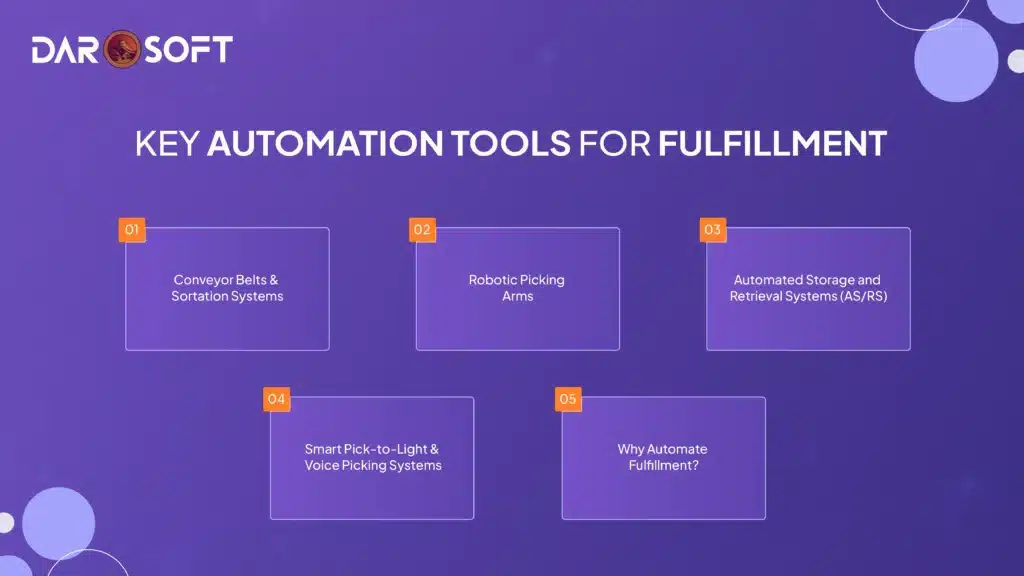
Key Automation Tools for Fulfillment
Conveyor Belts & Sort Systems
Move products seamlessly between zones with minimal human touch.
Integrated sorters automatically route items by size, weight, or destination.
Reduces walking time and manual hand offs, boosting speed and safety.
Robotic Picking Arms
Equipped with cameras and sensors to identify and grab specific SKUs.
Ideal for high-volume, repetitive tasks or environments with labour shortages.
Increase pick accuracy and operate 24/7 without fatigue.
Automated Storage and Retrieval Systems (AS/RS)
Store and retrieve items from high-density racks using shuttles or cranes.
Optimise vertical space and picking efficiency.
Great for e-commerce or SKU-heavy operations needing fast access and accuracy.
Smart Pick-to-Light & Voice Picking Systems
Guide workers through picking tasks using lights or voice commands.
Minimise training time and reduce picking mistakes.
Combine human flexibility with digital precision.
Why Automate Fulfillment?
Faster order processing: Pick and pack more orders per hour with fewer delays.
Higher accuracy: Reduce mis-picks, damaged goods, and costly returns.
Lower labour costs: Achieve more output with fewer workers, especially in peak seasons.
Scalability: Easily handle order spikes without losing control.
Labeling and Documentation: Small Task, Big Gains
Labeling and documentation might seem like minor steps in the warehouse workflow, but they can create major slowdowns if handled manually. From mislabeled packages to missing customs forms, small errors can lead to costly delays, compliance issues, and customer dissatisfaction.
That’s why automating these “small” tasks delivers big operational gains. Whether it’s printing shipping labels, generating invoices, or attaching the right documentation to outbound shipments, automation ensures everything is done quickly, accurately, and consistently.
What You Can Automate
Shipping Label Generation
Automatically create carrier-compliant labels for every order.
Integrate with couriers (FedEx, DHL, local providers) for real-time rate and service selection.
Prevent mislabeling with automated weight and destination checks.
Invoice & Packing Slip Creation
Auto-generate invoices and slips based on order data no manual entry.
Customise by client, destination, or region (e.g., B2B vs B2C).
Embed into pick-pack workflows for seamless dispatch.
Customs & Compliance Documentation
Automatically produce the correct export/import documents for international shipments.
Reduce delays at customs and avoid compliance penalties.
Dynamically populate forms with order, SKU, and customer data.
Benefits of Automating Documentation
Saves time: Eliminate repetitive tasks and let staff focus on value-added work.
Reduces errors: Avoid costly mistakes that lead to returns, delays, or fines.
Improves speed: Labels and docs are ready the moment an order is packed.
Supports global trade: Ensure proper compliance across multiple regions.
Connect Your Sales Channels
Orders can come from anywhere, your website, marketplaces, retail stores, or B2B clients. Without a centralised system, managing those orders turns into a chaotic mix of emails, spreadsheets, and manual data entry. That’s where order management integration steps in.
By syncing your eCommerce platforms (like Shopify, WooCommerce, or Amazon), POS systems, and ERP software with your warehouse, you create a real-time, unified order flow. This ensures every order is captured instantly, routed correctly, and fulfilled without delays or human error.
How Order Integration Works
eCommerce Sync
Automatically pulls new orders from your online store into your WMS or inventory system, no copying and pasting required.POS & Retail Sync
Connects in-store sales to your warehouse, ensuring accurate inventory across channels.ERP Integration
Aligns finance, procurement, and fulfillment teams by sharing order status, stock levels, and invoicing in one place.
When to Introduce AGVs and Robotics
Knowing when to let machines take the wheel.
Autonomous Guided Vehicles (AGVs) and warehouse robotics are no longer futuristic novelties; they’re practical tools for scaling operations, especially when labour is scarce, space is tight, and speed is everything. But timing their introduction is key.
These technologies require upfront investment, infrastructure, and workflow redesign. So, when does it make sense to bring them in? Here’s a breakdown to help you decide.
Signs You’re Ready for AGVs and Robotics
1. Labour Costs Are Rising or Staff Turnover Is High
Struggling to hire and retain warehouse workers?
AGVs can take over repetitive transport tasks like moving pallets or bins, cutting dependency on manual labour for basic movement.
2. High Volume, Repetitive Tasks
If your team is constantly moving goods between fixed zones (like receiving → storage or packing → shipping), AGVs can automate those routes.
Robotic arms can handle repetitive picking or packing tasks faster and with fewer errors.
3. Safety Risks in Material Handling
If heavy lifting, sharp turns, or long hauls are putting staff at risk, robots reduce accidents by navigating consistently and safely.
Ideal for large loads or hazardous zones.
4. You’re Running a Multi-Shift Operation
AGVs and robots don’t need breaks or overtime. In 24/7 warehouses, they pay off quickly by running continuously and predictably.
5. Tight Margins Require Precision
Robotics delivers consistent performance, helping you meet tight KPIs on throughput, delivery windows, and error reduction.
Not Ready Yet? Start with a Pilot
Test AGVs in a single zone or workflow (like pallet transport).
Use robotic picking in high-SKU or high-frequency areas first.
Monitor ROI, downtime, and team feedback before scaling.
AGV & Robotics Use Cases
Task | Best Tool | Benefit |
Pallet transport | AGV (fork-style) | Reduces manual hauling |
Tote/bin movement | AMR (Autonomous Mobile Robot) | Flexible routing, safe navigation |
Case/carton picking | Robotic arm or shuttle | Speeds up order picking |
Conveyor zone-to-zone handling | Conveyor + AGV handoff | Smooth inter-zone flow |
Data & Analytics: Automate Insights, Not Just Operations
Smart warehouses don’t just move faster, they think faster too.
While automation handles the physical side of warehousing, data and analytics bring the brainpower. It’s not enough to just automate tasks; you also need to automate how you understand and respond to them.
Modern warehouses use AI-powered dashboards, real-time alerts, and predictive analytics to turn raw data into instant, actionable insights. From forecasting demand spikes to spotting inventory variances or flagging bottlenecks, automated analytics helps you stay ahead instead of playing catch-up.
What You Can Automate with Data & Analytics
Real-Time Dashboards
Visualise inventory levels, order volumes, picking rates, and fulfillment times live.
Customise KPIs by role to give warehouse managers, procurement, and leadership the exact data they need.
Smart Alerts & Exception Reporting
Get notified when inventory drops below thresholds, pick rates fall, or orders are delayed.
AI-driven alerts can detect patterns before they become problems.
Demand Forecasting & Trend Analysis
Use historical data and AI models to predict future demand by SKU, season, or region.
Automate replenishment planning and reduce overstocking or stockouts.
Process Performance & Optimisation
Track metrics like pick accuracy, packing time, AGV uptime, and staff productivity.
Identify under performing zones, shifts, or workflows without needing a manual audit.
Scale Smart: Choose Modular Automation Over One-Time Fixes
Automation isn’t an all-or-nothing game; it’s a journey.
One of the biggest mistakes warehouses make when adopting automation is trying to “fix everything at once.” This often leads to overextended budgets, underused technology, and major disruption. The smarter path? Modular automation building in phases, starting where it matters most.
What Is Modular Automation?
Modular automation means implementing scalable, plug-and-play systems that solve immediate problems now and can be expanded as your needs evolve. It’s like upgrading your warehouse piece by piece, without pausing operations or over committing resources.
Benefits of Going Modular
Lower upfront investment: Start with key problem areas instead of funding a full overhaul.
Faster ROI: Begin seeing impact from Day 1 in high-impact zones like picking or inventory tracking.
Minimal disruption: Keep your operations running while adding automation in the background.
Scalability: Add modules as volume grows, whether it’s robotic picking, AGVs, or AI analytics.
Flexibility: Swap, update, or expand tools as your business shifts without being locked into rigid systems.
Where to Start
Begin with high-return areas:
Inventory tracking (barcode/RFID automation)
Order picking (pick-to-light or mobile devices)
Labeling & documentation (auto-print systems)
Order syncing (ERP/eComm integrations)
Once stable, expand into:
Robotic arms or conveyors
AGVs for internal transport
AI dashboards for smart decision-making
Logisticify: Your Automation Ally from Day One
Modernise with confidence, scale with precision.
Logisticify is built to be your warehouse automation partner from the very first step, helping you streamline operations, reduce errors, and make smarter decisions in real time.
Whether you’re just starting with barcode scanning or scaling up to AI-powered analytics, Logisticify grows with you no need for massive upfront investment or disruptive system overhauls.
What Logisticify Automates for You
Inventory Management
Track stock in real time with barcode and RFID integration
Automatically update counts across channels
Order Syncing Across Systems
Seamless integration with eCommerce, ERP, and POS platforms
No more double entries, missed orders, or manual reconciliations
Ensure fast, accurate fulfillment from sale to shipment
Real-Time Dashboards & Reporting
Monitor KPIs like pick accuracy, fulfillment speed, and stock levels
Receive instant alerts on exceptions and variances
Make proactive decisions with AI-powered insights
Modular & Scalable
Start small, automate where it hurts most. Then expand.
Logisticify’s modular setup lets you:
Add new users or locations easily
Integrate robotics or AGVs when you’re ready
Customize workflows to fit your exact processes
Built for Modern Warehousing
Cloud-based and mobile-friendly
Secure, with role-based access and audit trails
Intuitive UI for quick adoption by your team
Ready to move from chaos to control?
Logisticify isn’t just software, it’s a smarter way to work.
See it in action →
Start automating what matters. Scale when you’re ready: With Logisticify, you’re not just keeping up, you’re staying ahead.