- Written by: Hummaid Naseer
- September 23, 2025
- Categories: Services & Products
For inventory managers, one of the toughest tasks is deciding which products to restock first. With hundreds or even thousands of SKUs in play, it’s easy to get overwhelmed and make costly mistakes like overstocking items that barely sell while accidentally running out of high-value products that drive revenue.
The reality is that not all stock contributes equally to sales, profits, or customer satisfaction. Some items are business-critical, while others are slow movers that tie up cash and warehouse space. Treating every SKU the same creates inefficiencies that ripple across the supply chain.
This is where ABC Analysis reports become a powerful tool. By categorizing products based on their impact on sales and profitability, ABC Analysis helps businesses prioritize replenishment strategically, ensuring that the most valuable items are always available while minimizing waste and excess stock.
What Is ABC Analysis? (Detailed)
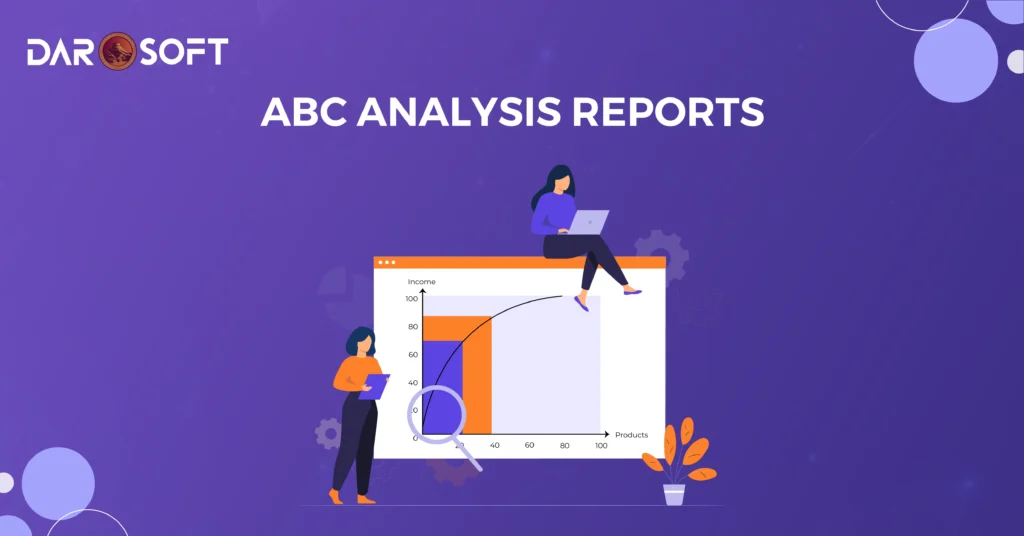
ABC Analysis is an inventory classification method that ranks items by their economic impact so you can focus time and money where they matter most. It applies the Pareto idea (a small share of items drives a large share of value) to inventory management.
At a glance:
A items → Few SKUs, most of the value (revenue/consumption/profit).
B items → Moderate count, moderate value.
C items → Many SKUs, small share of value.
How the categories are derived
Most teams compute each SKU’s annual consumption value (ACV):
ACV = Unit Cost × Annual Usage (or Sales Volume)
(You can swap in revenue or gross margin if that’s how you measure “value.”)
Steps:
Calculate ACV for every SKU.
Sort SKUs by ACV (highest → lowest).
Compute the cumulative % of total ACV.
Apply cutoffs (typical, adjust to your business):
A: Top ~70–80% of cumulative value (often only 10–20% of SKUs)
B: Next ~15–25% of cumulative value (≈20–30% of SKUs)
C: Remaining ~5–10% of value (often 50–70% of SKUs)
Your exact thresholds should reflect service goals, cash constraints, and risk tolerance.
A/B/C defined (with management intent)
A Items (High-Value, Low-Quantity)
Profile: ~10–20% of SKUs → 70–80% of value.
Impact: Stockouts hurt revenue and customer satisfaction.
Policy hints: Tight planning, frequent reviews, low safety stock (but high service level), reliable suppliers, shorter order cycles.
B Items (Moderate Value)
Profile: ~20–30% of SKUs → 15–25% of value.
Impact: Important but not mission-critical.
Policy hints: Weekly/monthly reviews, moderate service levels, balanced order quantities.
C Items (Low Value, High Count)
Profile: ~50–70% of SKUs → 5–10% of value.
Impact: Stockouts are often low risk; over-control wastes effort.
Policy hints: Simplify—bulk buys, longer cycles, vendor-managed inventory where possible, periodic rather than continuous review.
Quick numeric example
SKU | Unit Cost | Annual Use | ACV (Cost×Use) | Cum. % of Value | Class |
P1 | 50 | 1,000 | 50,000 | 52.6% | A |
P2 | 120 | 200 | 24,000 | 78.9% | A |
P3 | 10 | 800 | 8,000 | 87.4% | B |
P4 | 20 | 400 | 8,000 | 95.8% | B |
P5 | 1 | 5,000 | 5,000 | 100% | C |
Totals: ACV = 95,000. Using 80%/95% cutoffs → A: P1–P2, B: P3–P4, C: P5.
How ABC drives replenishment decisions
Service levels (fill rate targets): A: 98–99% | B: 95–97% | C: 90–92%
Review cadence: A: continuous/daily | B: weekly | C: monthly/quarterly
Safety stock: A: optimized via variability + lead time (protect revenue) | B: moderate | C: minimal
Order quantity: A: smaller, frequent (reduce cash tied up) | C: larger, infrequent (reduce ordering cost)
Supplier strategy: A: dual sourcing/SLA-backed | C: consolidate and simplify
Cycle counting: A: weekly | B: monthly | C: quarterly
Tie to ROP/Min–Max:
ROP = Demand during Lead Time + Safety Stock
Calibrate higher service levels and tighter monitoring for A items.
Variations & refinements (to improve accuracy)
Use Margin, not Cost: If profits matter more than spend, classify by gross margin value instead of cost.
Combine with XYZ (demand variability): Create classes like AX (high value, stable demand) vs AZ (high value, erratic demand) to fine-tune safety stock.
Consider criticality & substitutability: A low-cost part with no substitute or long lead time might be promoted to A on risk grounds.
Seasonality & lifecycle: Reclassify before peak seasons; treat new SKUs cautiously (insufficient history).
Data hygiene: Bad usage or cost data = wrong classes; audit regularly.
Governance & cadence
Refresh classifications monthly or quarterly (faster in volatile environments).
Track KPIs by class: fill rate, stockouts, inventory turns, holding cost, and obsolescence.
Review exceptions: expensive stockouts, chronic overstock, supplier slippage.
Why ABC Analysis Matters for Replenishment
When it comes to inventory, not all stockouts carry the same weight. Running out of an A-category item—one that drives most of your revenue—can have serious consequences: lost sales, production stoppages, and dissatisfied customers. By contrast, a shortage of a low-value C-category item may only cause minor inconvenience and little to no impact on profitability.
This is why ABC Analysis is so powerful in stock replenishment. It ensures inventory managers don’t treat every SKU equally but instead align resources and attention with the true business value of each product.
By leveraging ABC Analysis reports, managers can:
Focus resources on high-priority items
Ensure that critical A-items are always available, using tighter monitoring, shorter reorder cycles, and higher safety stock levels.Avoid tying up capital in low-value stock
Reduce unnecessary investments in C-items, which often contribute little to revenue but consume significant warehouse space and working capital.Reduce the risk of lost sales on critical products
By giving A-items priority, businesses can prevent costly stockouts that damage customer trust and disrupt operations.Balance service levels with efficiency
Apply differentiated replenishment policies—high service levels for A-items, moderate for B-items, and simplified processes for C-items—optimizing both cost and availability.
How to Use ABC Analysis Reports for Replenishment
ABC Analysis is most effective when it shapes your replenishment policies instead of applying a one-size-fits-all approach. Each category—A, B, and C—requires a distinct strategy that reflects its business impact, sales contribution, and risk profile.
Prioritize “A” Items (High Value, Low Quantity)
A-items are your most critical SKUs. They often represent just 10–20% of your inventory but contribute 70–80% of total value. A single stockout here could mean substantial lost revenue, production downtime, or angry customers.
Best Practices:
Frequent Monitoring: Track sales, turnover, and stock levels daily (or even in real-time using ERP/IMS tools). Small fluctuations can have big consequences.
Safety Stock: Maintain a calculated buffer stock based on demand variability and lead times. For high-demand items, a 5–10% safety margin can prevent disruptions.
Automated Reordering: Set system alerts or auto-replenishment rules to trigger purchase orders before stock levels fall below the reorder point.
Supplier Collaboration: Build close partnerships with suppliers—negotiate faster lead times, prioritize deliveries, or even establish vendor-managed inventory (VMI).
Example: A car manufacturer closely tracks a premium brake system component (A-item). Any shortage could halt assembly lines, so they keep a buffer and have suppliers on standby.
Manage “B” Items with Balance (Moderate Value, Moderate Quantity)
B-items typically account for 20–30% of SKUs, generating 15–25% of value. They are important but not mission-critical, requiring a balance of cost control and availability.
Best Practices:
Periodic Review: Monitor sales and turnover weekly or monthly, depending on demand patterns.
Seasonal Adjustments: Align replenishment with known demand cycles, like holiday sales or production peaks.
Cost-Efficient Orders: Optimize purchase quantities by negotiating bulk discounts, without overstocking.
Service Levels: Set moderate service targets (e.g., 90–95%) compared to A-items, which often require near-100%.
Example: A clothing retailer treats mid-range jeans as B-items. They are steady sellers, but occasional stockouts won’t severely impact revenue. Replenishment is planned monthly with bulk orders.
Simplify Control of “C” Items (Low Value, High Quantity)
C-items usually represent 50%+ of total SKUs but only contribute 5–10% of value. Over-investing time and money in managing them adds little business benefit.
Best Practices:
Simplified Procurement: Use blanket purchase agreements or standing orders to automate replenishment in large but infrequent batches.
Lower Monitoring Frequency: Track monthly or quarterly; daily reviews aren’t worth the effort.
Lean Inventory Levels: Stock enough to avoid frequent reorders, but don’t overstock since carrying costs can outweigh their contribution.
Warehouse Optimization: Store C-items in less accessible areas of the warehouse, prioritizing prime space for A- and B-items.
Example: Office supplies like pens and notepads in a corporate warehouse. Stockouts cause little disruption, so replenishment happens in bulk once per quarter.
Benefits of ABC-Based Replenishment
Implementing replenishment strategies based on ABC Analysis brings structure and focus to inventory management. Instead of spreading resources thin across every SKU, businesses can direct time, capital, and attention toward the items that truly drive value.
Greater Efficiency
By differentiating between A, B, and C items, teams avoid wasting time micro-managing low-value stock. Planners, buyers, and warehouse staff can channel their energy into monitoring and replenishing the SKUs that have the biggest financial and operational impact.
Result: Smarter workflows, less administrative overhead, and a sharper focus on critical items.
Cost Savings
Slow-moving products (C-items) often trap working capital and inflate carrying costs like storage, insurance, and depreciation. With ABC-based replenishment, businesses can prevent overstocking of these items while ensuring funds are invested where they yield the highest return.
Result: More liquidity, lower holding costs, and healthier cash flow.
Improved Customer Satisfaction
Stockouts of A-items can frustrate customers, erode trust, and drive them to competitors. By giving top priority to replenishing high-value SKUs, businesses ensure critical products are always available, improving service levels and customer loyalty.
Result: Fewer lost sales, repeat customers, and a stronger brand reputation.
Better Supplier Relationships
With ABC Analysis, procurement teams know which vendors supply the most important items. This clarity allows them to build stronger relationships with A- and B-item suppliers through priority contracts, collaboration on forecasting, and negotiated service levels.
Result: More reliable supply chains, faster lead times, and better terms with strategic vendors.
Balanced Inventory Strategy
Instead of applying a one-size-fits-all approach, ABC-based replenishment ensures resources are distributed intelligently—tight control over A-items, balanced management of B-items, and simplified handling of C-items.
Result: Optimal balance between availability, cost efficiency, and operational simplicity.
Practical Example: ABC Analysis in Action
Consider an electronics distributor managing 5,000 SKUs. The company struggled with frequent stockouts of high-demand items while simultaneously carrying excess stock of slow movers, which tied up capital and warehouse space. By implementing ABC Analysis reports, they were able to bring structure and clarity to their replenishment strategy:
A Items (High Value, High Impact): Premium products such as the latest smartphone models and high-end laptops. These were monitored daily, with automated reorder points and close coordination with suppliers to guarantee availability.
B Items (Moderate Value): Mid-tier products such as chargers, headphones, and protective cases. These were reviewed weekly, with replenishment planned around seasonal demand trends and negotiated in moderate bulk for cost efficiency.
C Items (Low Value, High Quantity): Low-margin products like generic USB cables and small replacement parts. These were reordered monthly in bulk using blanket purchase agreements to minimize administrative work and reduce procurement costs.
The Results:
Stockouts of critical A-items dropped by 40%, ensuring customers always had access to the most in-demand products.
Warehouse carrying costs decreased by 15%, thanks to reduced overstocking of low-value C-items.
Procurement teams could focus their energy on managing key supplier relationships instead of being bogged down by low-impact items.
Conclusion
Effective inventory management is ultimately about finding the right balance between availability, cost, and efficiency. Without a structured approach, businesses risk tying up capital in low-value stock while missing out on sales from critical products.
ABC Analysis transforms replenishment from a reactive, one-size-fits-all task into a strategic decision-making process. By segmenting inventory into A, B, and C categories, managers can:
Give priority to high-value items, ensuring they’re always available to meet customer demand.
Apply balanced strategies to mid-tier products, keeping them in stock without excessive investment.
Simplify control of low-value items, freeing up resources and warehouse space for what really matters.
The outcome is a smarter, leaner, and more profitable replenishment process. Businesses not only cut costs and improve cash flow but also strengthen customer satisfaction and supplier relationships.